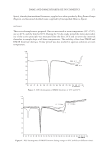
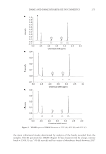
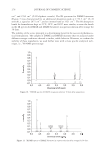
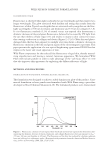
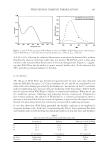
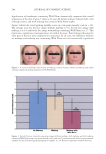
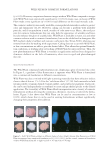
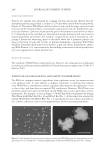
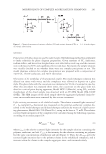
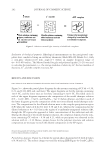
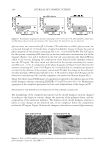
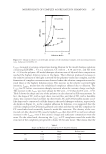
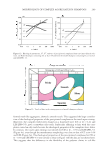
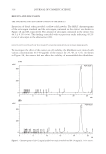
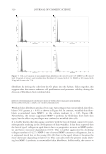
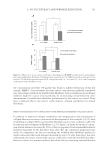
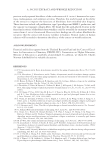
JOURNAL OF COSMETIC SCIENCE 272 Measurements were made in triplicate for each formula at each sampling time and storage temperature. The results are reported here as the mean of the three values ± standard deviation. All results were compared by analysis of variance (ANOVA) to identify sig- nifi cant differences. Differential scanning calorimetry. The DSC thermograms of DMAE bitartrate were recorded with a Mettler FP80 differential scanning calorimeter, from 50°C to 300°C, at a rate of 5°C/min. Test samples weighing 5–6 mg were analyzed in crimped aluminium sample pans. Ultraviolet spectroscopy. Ultraviolet spectra were recorded with a Perkin Elmer UV/Vis spectrometer. A precisely weighed amount of the active principle was dissolved as appro- priate, and scans were obtained at wavelengths of 200–300 nm. Infrared spectroscopy. Infrared spectra were recorded with a Perkin Elmer FT-IR Spectrum One instrument. Solid samples were analyzed with potassium bromide, and liquid sam- ples were analyzed with sodium chloride disks. Figure 5. DSC thermograms of DMAE bitartrate during storage at 60°C (stability at different times). Figure 6. FTIR spectra of DMAE.

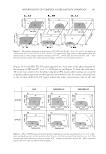
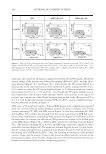
DMAE AND DMAE BITARTRATE IN COSMETICS 273 Nuclear magnetic resonance. The 1 H-NMR spectra were recorded with Varian Direct drive (400 MHz) spectrometers for solutions in D2O. RESULTS AND DISCUSSION DIFFERENTIAL SCANNING CALORIMETRY Figure 2 shows the thermogram of DMAE bitartrate at room temperature. Two endother- mal peaks were evident: one at 67.1°C and a larger peak at 113.6°C that marked the melt- ing point (melting range: 112.7°–118.2°C). The heat exchanges for these peaks were 55 J/g and 114 J/g. The basal heat curve showed signs of shift between 200°C and 212°C. Stability was evaluated by comparing the DSC thermograms obtained at room tempera- ture with those recorded at 40°C and 60°C. Figure 3 shows the results for DMAE bitar- trate at each temperature. The endothermal peak at 67.1°C was no longer evident, although large peaks were seen at 114.5°C (40°C) and 115.1°C (60°C). Disappearance of the smaller endothermal peak may indicate loss of occluded water due to crystallization as a result of evaporation after storage of the samples at a the two higher temperatures. Figures 4 and 5 compare the stability of DMAE bitartrate at different times in samples kept at room temperature versus 40°C or 60°C. The behavior at days 7, 14, and 30 was similar to that of the room-temperature samples, and the endothermal peak remained unchanged. Calorimetric tests thus detected no changes in any of the samples kept at 25°C, 40°C, or 60°C for different periods. All curves showed the characteristic melting point for DMAE bitartrate. ULTRAVIOLET SPECTROSCOPY The spectra showed no clear peaks for maximal absorbance, and so the UV spectros- copy results were uninformative for the purposes of characterizing DMAE and DMAE bitartrate. Figure 7. FTIR spectra of DMAE bitartrate.
Purchased for the exclusive use of nofirst nolast (unknown)
From: SCC Media Library & Resource Center (library.scconline.org)