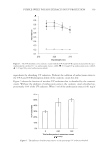
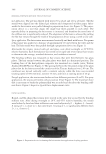
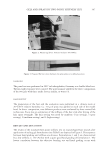
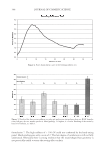
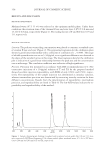
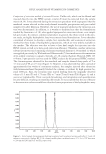
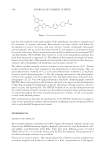
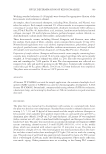
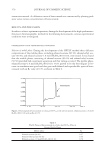
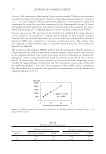
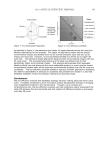
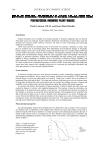
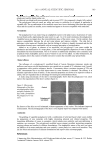
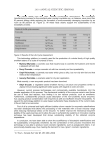
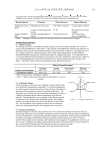
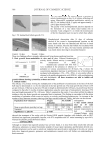
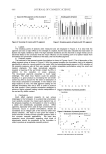
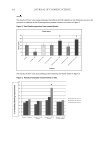
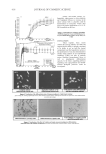
JOURNAL OF COSMETIC SCIENCE 346 BENDING STIFFNESS METHOD: TWO-POINT FLAT Gel application. The gel was diluted with water (50 g of gel and 140 g of water). The fl at strains were dipped into the diluted gel solution and compressed on fi lter paper. After- wards the hair strains were pulled through a preparation device (see Figure 1). The prepa- ration device is a tool that aligns the single hair fi bers parallel to each other. The reproducibility in preparing the hair tresses is increased, and therefore the error limit of the stiffness test is signifi cantly reduced. The alignment of the hairs is achieved by pulling the fl at hair tresses through the mold of the preparation device using a comb at one side. Spray application. The hair strains were mounted vertically and fi xed with braces. Ten grams of hair spray was applied at a distance of approximately 20 cm between the valve and the hair. The hair strains were then pulled through a preparation device (see Figure 1). Afterwards the strains, treated with gel and spray, were dried overnight at 20°C/65% relative humidity. Each formulation was tested on ten (gel) and seven (spray) hair strains to determine the average, standard deviation, and confi dence interval. The bending stiffness was measured on hair strains that were fi xed between two glass plates. The hair strains between the glass plates were fi xed in a horizontal position. The bending force of the hair/polymer composite was measured in a tensile tester, Texture AnalyzerTA.XTPlus (see Figure 2). The spacing between the two points (edge of the glass plates that fi x the hair tress and the cantilever of the Texture Analyzer) was 2.00 cm. The cantilever was moved vertically with a constant velocity while the force was recorded (starting speed of 500 mm/min, traverse 55 mm, and force at starting point of 20 g). For gel application, the strains were broken at four different positions (A to D). For spray application, the strains are broken only at position D (see Figure 3). The maximum force that is necessary to break the polymer fi lm was recorded and describes the bending stiff- ness forces. Figure 4 depicts a typical force displacement curve. HAND GRADING Round- and fl at-shaped hair strains were treated in the same way as used for the bending stiffness tests. After drying overnight at 20°C and 65% relative humidity, the strains were broken by hand and their stiffnesses were rated subjectively (1 = highest, 4 = lowest). A rating of 1- is closer to 1, but rated lower. A rating of 1- is signifi cantly different from 2+, i.e., closer to 2. Figure 1. Preparation device for forming fl at hair strains after application of styling products.

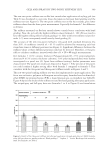
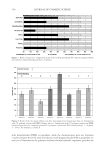
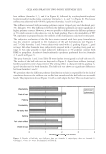
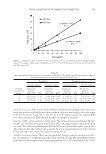
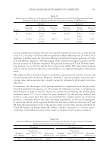
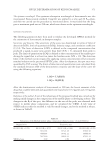
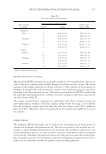
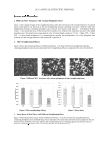
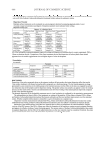
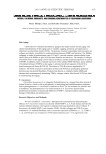
GELS AND SPRAYS IN TWO-POINT STIFFNESS TEST 347 PANEL TEST The panel test was performed in 2007 in Ludwigshafen, Germany as a double-blind test. Twenty-eight responses were counted. The questionnaire asked for the direct comparision of the two gels with three ranks: better, similar, or worse (4). HALF-SIDE TEST The preparation of the hair and the evaluation were performed in a climate room at 20°C/65% relative humidity. Ca. 3.8 g of spray was applied on each side of the model head. In direct comparision, two different products were evaluated by three trained lab technicians. Focus was on estimation of the stiffness of the hair style after drying of the hair spray overnight. The hair setting was rated by numbers 4 (no setting), 3 (poor setting), 2 (medium setting), and 1 (high setting). RESULTS AND DISCUSSION The results of the standard three-point stiffness test on round-shaped hair strands after application of styling gel formulations (see Table I) are depicted in Figure 5. Discrepances between hand grading and stiffness are obvious. Formulations 1 and 2 are characterized by a low stiffness ( 150 cN) but with a quite good hand grading of formulation 1. The lowest correlation between the objective bending test and hand grading occurs with Figure 2. Measuring device: Texture Analyzer TA.XTPlus. Figure 3. Prepared fl at hair strain between two glass plates at a defi ned position.
Purchased for the exclusive use of nofirst nolast (unknown)
From: SCC Media Library & Resource Center (library.scconline.org)