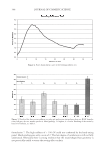
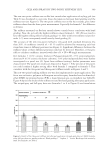
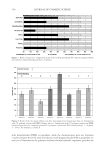
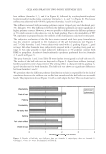
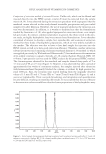
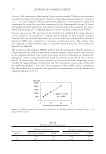
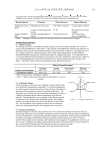
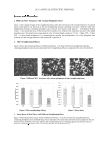
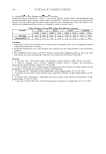
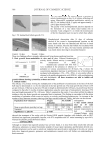
JOURNAL OF COSMETIC SCIENCE 344 evaluated by Frosch and Vogel (1), is the three-point bending stiffness test. Alternatively, the omega-loop method (2) can be used. Depending on the application and type of formulation, the correlation of the objective stiffness test with the subjective consumer relevant tests is limited. OBJECTIVE OF THE STUDY The objective test, e.g., the three-point stiffness test on round-shaped hair strains (1), has limited correlation with the afore-mentioned consumer-relevant tests. This is especially a problem for the assessment of the styling performance of hair gels. There is a need for improved objective tests and a closer correlation with practically relevant tests. Tests on hair gels with combinations of different thickeners and styling polymers will be investigated by means of a new two-point bending stiffness test on fl at hair strains. The results will be correlated with the subjective tests on these hair strains and by means of a panel test for selected formulations. In conventional stiffness tests for hair sprays, multiple application procedures are often applied, e.g., by means of a syringe or by dip- ping the hair strains into the hair spray solution without a propellant (1). Any infl uence of these factors, such as propellants, solvents, water, and valve cannot be considered in the conventional bending test after dipping. In our new approach we use a two-point bending stiffness test in which fl at hair strains are used after practically relevant spray application. EXPERIMENTAL MATERIALS Round- shaped (2.9–3.3 g, 26 cm) and fl at (2.9–3.3 g, 20cm) hair strains from Kerling (Caucasian, virgin brown hair, Art- Nr. 826550) were used. Model heads (Caucasian dark brown hair) from Wernesgruen, Germany, were used for half-side tests. All hair strains and model heads were washed twice with a solution of 27–28% sodium laureth sulfate. FORMULATIONS Gel and spray formulations tested for bending stiffness are listed in Tables I and II. BENDING STIFFNESS METHOD: THREE-POINT ROUND Hair strains (2.9–3.3 g, 26-cm round shape) were dipped repeatedly into the diluted gel (50 g of gel and 140 g of water) or in the spray solution without propellant. Excess gel or spray was wiped off and the hair strains were lightly compressed on fi lter paper. After- wards the hair strains were formed with fi ngers until they were round-shaped. The strains were dried overnight at 20°C and 65% relative humidity. The measurement of the bending stiffness was performed on a Karg tensile tester (TT 27025E6). The spacing between

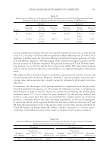
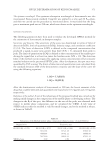
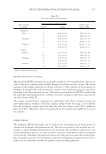
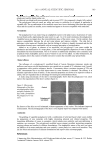
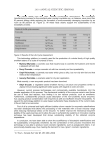
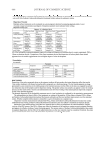
GELS AND SPRAYS IN TWO-POINT STIFFNESS TEST 345 points 1 and 2 (cantilever) as well as between points 2 (cantilever) and 3 was 4.40 cm. The cantilever was moved vertically with a constant velocity while the force was recorded (constant speed of 500 mm/min, traverse 40 mm). The maximum force that is necessary to break the polymer fi lm was recorded and describes the bending stiffness forces. Each sample was tested with at least seven different hair strains to determine the average and standard deviation (1,3,4). Table I Gel Formulations Tested for Bending Stiffness No. Formula 1 1.00 g Acrylates/beheneth-25 methacrylate copolymer (Rohm & Haas Company) 12.50 g VP/methacrylamide/vinyl imidazole copolymer (BASF SE) (2.50 g polymer content) 100.00 g water 2 1.00 g Acrylates/beheneth-25 methacrylate copolymer (Rohm & Haas Company) 12.50 g PVP 20% solution (BASF SE) (2.50 g polymer content) 100.00 g water 3 1.00 g Polyquaternium-86 (BASF SE) 12.5 g PVP 20% solution (2.50 g polymer content) 100.00 g water. 4 0.50 g Carbomer (Lubrizol Corp.) 15.0 g PVP 20% solution (BASF SE) (3.00 g polymer content) 100.00 g water. 5 0.50 g Carbomer (Lubrizol Corp.) 2.50 g Polyquaternium-11 (BASF SE) (0.50 g polymer content) 12.5 g PVP 20% solution (BASF SE) (2.50% polymer content) 100.00 g water. 6 Market formulations with carbomer (Lubrizol Corp.) VP/VA copolymer and PVP (BASF SE) 7 Market formulations with carbomer (Lubrizol Corp.) and AMP-acrylates/allyl methacrylate copolymer (Lubrizol Corp.) All formulas contained 0.90 g phenoxyethanol/ethylhexylglycine as a preservative. Table II Spray Formulations Tested for Bending Stiffness No. Formula 1 3.00 g Octylacrylamide/acrylates/butylaminoethyl methacrylate copolymer (Akzo Nobel Surface Chemistry) 0.53% AMP 40.00 g DME 100.00 g ethanol 96% (neutralization grade of polymer: 90%) 2 3.00 Acrylates/t-butylacrylamide copolymer (BASF SE) 0.35 g AMP 40.00 g DME 100.00 g ethanol 96% (neutralization grade of polymer: 100%) 3 3.00 g VP/VA/copolymer (BASF SE) 40.00 g DME 100.00 g ethanol 96% 4 5.00 g Octylacrylamide/acrylates/butylaminoethyl methacrylate copolymer (Akzo Nobel Surface Chemistry) 0.53 g AMP 40.00 g DME 100.00 g ethanol 96% (neutralization grade of polymer: 90%) 5 5.00 g Acrylates/t-butylacrylamide copolymer 0.35 g AMP 40.00 g DME 100.00 g ethanol 96% (neutralization grade of polymer: 100%) 6 5.00 g VP/VA copolymer (BASF SE) 40.00 g DME 100.00 g ethanol 96% 7 3.00 g Octylacrylamide/acrylates/butylaminoethyl methacrylate copolymer (Akzo Nobel Surface Chemistry) 0.53 g AMP 40.00 g P/B 100.00 g ethanol 96% (neutralization grade of polymer: 90%) 8 3.00 g Acrylates/t-butylacrylamide copolymer (BASF SE) 0.35 g AMP 40.00 g P/B 100.00 g ethanol 96% (neutralization grade of polymer: 100%) DME: dimethylether P/B: propane/butane (25%/75%) AMP: 2-amino-2-methyl-1-propanol.
Purchased for the exclusive use of nofirst nolast (unknown)
From: SCC Media Library & Resource Center (library.scconline.org)