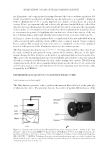
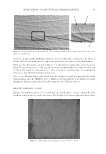
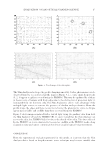
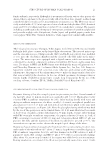
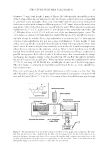
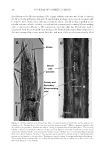
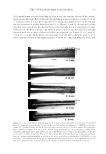
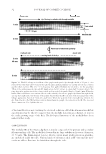
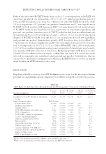
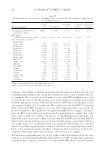
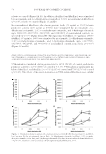
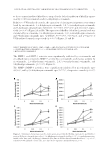
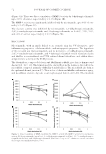
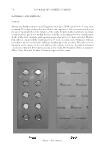
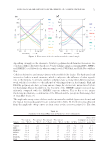
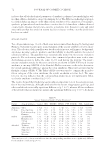
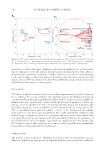
JOURNAL OF COSMETIC SCIENCE 14 Figure 5. Needle ma ps and reconstructed results of the ball bearing from the Skin Analyzer and theoretic results calculated from an ideal sphere model. amplitude of the vectors. It is found that most of the semisphere can be recovered cor- rectly using the photometric stereo technique. Figures 5C and D are 3D profi le of the ball bearing reconstructed from photometric stereo (left) and theoretically calculated with the known diameter (right). The least squares mean diameter fi tted from the reconstructed data gives the results of 10.2 mm diameter. Although deviation from the ground truth has been observed, the result is quite close to that of the ground truth. In fact, the error associated with the result may be caused by the integration approach which inherently accumulates the error from noise or digitization. Figure 6A–D are needle maps of the whole replica and specifi ed smaller area in Figure 3. The two images on the left are the gradient data from the Skin Analyzer and the two on the right are the results extracted from the data acquired by the PRIMOS. It can be found that the Skin Analyzer demonstrates higher sensitivity as there are more vectors with long amplitude. However, several evident vectors (within three circles) with large amplitude presented in Figure 6B appear to be outliers which may result from prob- lematically transforming from the 3D profi le to gradient. In Figure 6D, a line of vec- tors (on the edge which can be observed in Figure 3) stand out dramatically in the downward direction, whereas the vectors shown in Figure 6C change their values relatively smoothly.

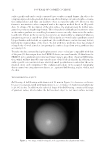
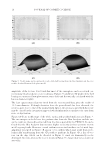
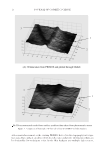
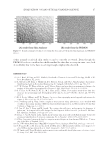
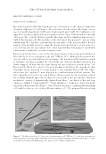
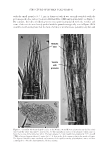
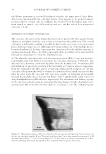
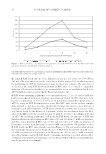
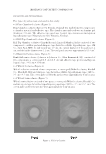
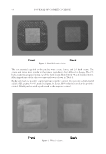
EVALUATION ON AN OPTICAL SCANNING DEVICE 15 Figure 6. Needle map s of the skin replica. The Skin Analyzer also keeps the profi le changing smoothly. Such a phenomenon can be observed from the reconstructed profi le maps in Figure 7, i.e., some small deeper holes (1, 2, 3) appear roughly recovered using the PRIMOS. This may be explained by a failure in the recovery of features with sharp edges due to the obstruction of projection light il- luminated from one direction only. The Skin Analyzer is able to take advantage of the multiple light sources to remove the presence of shadow and specularities. From the profi le maps, the edges and holes reconstructed using the photometric stereo technique appear more reliable and credible than those recovered from the PRIMOS. Figure 8 shows images rendered with a virtual light using the gradient data from both the Skin Analyzer (A) and the PRIMOS (B). It can be found that the Skin Analyzer can recover the skin, but PRIMOS failed to detect the details of live skin. The data collected by the PRIMOS on in vivo skin tend to be even less credible as the PRIMOS needs a long acquisition time and cannot compensate for object (usually human being) movement. CONCLUSION From the experimental evaluation presented in this article, it is proven that the Skin Analyzer device based on the photometric stereo technique may be more suitable than
Purchased for the exclusive use of nofirst nolast (unknown)
From: SCC Media Library & Resource Center (library.scconline.org)