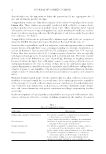
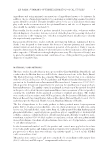
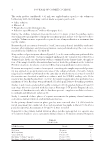
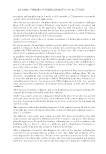
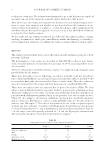
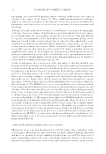
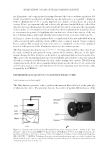
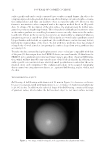
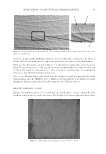
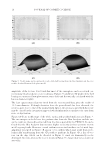
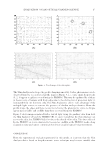
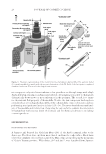
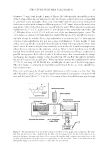
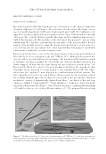
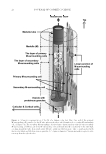
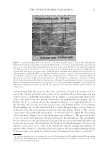
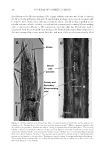
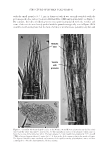
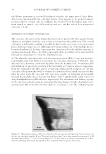
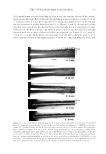
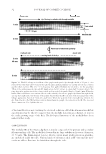
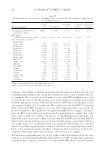
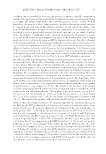
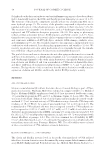
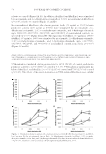
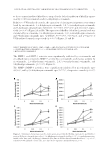
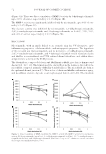
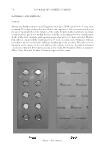
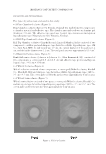
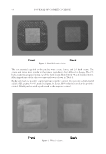
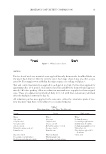
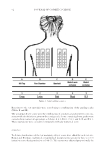
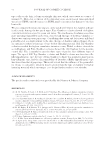
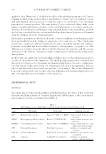
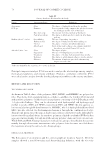
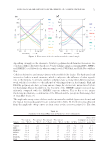
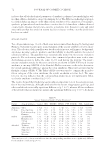
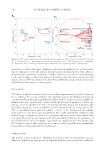
STRUCTURE OF HUMAN SCALP HAIR−II 25 RESULTS AND DISCUSSION MORPHOLOGY OF MEDULLA Recently, we reported the following microscopic observations on the cellular components of human scalp hairs (1) see Figure 1. The cuticular cell took a trowel-like shape, consist- ing of a handle-shaped part (CuH) and a blade-shaped part (CuB). The CuB parts over- lapped one another and partially fused together to form a layer (CuP) within the cuticular cell region. The cortical cell had a spindle-like shape and was similar in dimensions to CuH of the cuticular cell. The medulla, on the other hand, was appeared to possess a thin tubular wall. We, therefore, performed in the fi rst phase of the present study a detailed analysis of the medulla structure, using the aforementioned advantages of optical micros- copy. For this aim, the hair samples were either digested thin with papain or sliced with a microtome or randomly cut with a rotating cutter. Figure 4 shows the time course of the structural change of the young girl’s black hair fi ber (jf8) by an action of papain in the pH 7/PBS at 30°C. Although the inverted mi- croscope did not provide high-resolution images, the digestion of the hair fi ber seemed to take place in a phased manner. In other words, the outmost cuticular cell region was slowly stripped off from the hair shaft during the fi rst incubation period (about 5 h) Figure 4A–D. Then, the cortical cell region was digested within 2 h to provide the thin remainder which appeared to consist mainly of the medulla Figure 4E. The elders’ white hairs (jf65 and jm67) were digested in a similar fashion with the enzyme. The thin remainder such as the one seen in Figure 4E was useful for the structural study of the medulla. Namely, upon the mechanical cutting which was described in “Random mechanical cutting of enzymatically thinned hair fi bers,” two kinds of fl at and long substances (width 4–8 μm, length 70–90 μm, thickness 2–3 μm) were formed from the remainder as demonstrated in Figure 5. One of them is assigned as “a primary M-surrounding cell” and the other as “a secondary M-surrounding cell.” The primary M-surrounding Figure 5. The white ha ir fi ber (jf65) was treated with papain in pH 7/PBS at 30°C and then randomly cut Giemsa staining see the procedure “Random mechanical cutting of enzymatically thinned hair fi bers.” Panels (A and B) with bright fi eld illumination the panel (C) with oblique illumination.

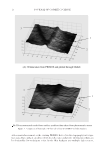
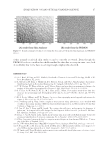
JOURNAL OF COSMETIC SCIENCE 26 Figure 6. Schematic represe ntation of the M of a human scalp hair fi ber. One end of the primary M-surrounding cell is attached to the M tube, whereas the other end is bound to the secondary M-surrounding cell cf. Figure 5A. The secondary M-surrounding cell also forms a linear junction with the other secondary M-surrounding cell. Hence, all of the M-surrounding cells are bound directly or indirectly to the tube wall, covering around the tube. In general, adults’ M tube, unlike an elderly persons’ tube, is neatly packed with the vesicles which are full of proteinous granules (0.5–1 μm in diameter). Various materials in aqueous solu- tion may fl ow through the tube.
Purchased for the exclusive use of nofirst nolast (unknown)
From: SCC Media Library & Resource Center (library.scconline.org)