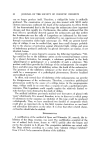
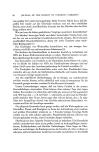
J. Soc. Cosmet. Chem., 25, 67-71 (February 1974) Fluorometric Determination of hyd ' ' Formalde e Cosmetic Products CLIFTON H. WILSON, Ph.D.* Presented October 11-14, 1971, Joint Symposium of the Society of Cosmetic Chemists and the Association of O•ficial Analytical Chemists, Washington, D.C. Synopsis--To overcome interference by perfume ingredients, a method has been devel- oped for determining FORMALDEHYDE in COSMETICS by forming a FLUORESCENT LUTIDINE DERIVATIVE and measuring the fluorescence on a SPECTROPHOTO- FLUOROMETER. Satisfactory recoveries were obtained from samples of shampoos, bath oils, hair cosmetics, lotions, and creams to which formaldehyde had been added. Formaldehyde was also determined in commercial samples of nail hardener, bubble bath, hair rinse, and shampoos. Of seven other aldehydes examined, only an aryl sulfonamide- formaldehyde resin gave a false positive test. INTRODUCTION Formaldehyde is used in a variety of cosmetics, particularly shampoos, an antibacterial agent and preservative. It is usually determined colorimetri- cally with chromotropic acid (1). One difilculty with this technique is that some perfume ingredients used in shampoos liberate formaldehyde in an acid medium and give a false positive test. A method using fluorometry (2) has been developed for determining for- maldehyde. In this method, formaldehyde is condensed with acetylacetone and ammonia to give a colored, highly fluorescent lutidine derivative. This reaction is shown in Fig. 1. d-I•i•ision of Cosmetics Technology, Food and Drug Administration, U.S. Department of Health, Education, and Welfare, Washington, D.C. 20204. 67

68 JOURNAL OF THE SOCIETY OF COSMETIC CHEMISTS • H•C.,• 0 0 0 II II cH 2 II c%-c ,, 3C..c c CH 3 CH-- / k ,C--CH 3 }I 2 o II II + c --CH CHf--C• CHo--C. O/f c-- c•3 'N '/ 3 I ! Figure 1. Condensation reaction of acetylacetone and formaldehyde EXPERIMENTAL MATERIALS AND MEXttODS The acetylacetone* should be freshly distilled and free of color or fluores- cence. An aqueous solution containing 0.2 ml of acetylacetone, 0.3 ml of gla- cial acetic acid, and 15.4 g of ammonium acetate in 100 ml of distilled water is prepared fresh each week. Standard solutions of formaldehyde are prepared fresh each day. From a Mohr piper, 0.27 ml of 36.8% commercial formaldehyde solution* is added to a 100-ml volumetric flask and made to volume with 10-12% methanol (0.1%, i mg/ml formaldehyde) a 1-ml aliquot of this solution is diluted to 100 ml with 10-12% methanol (0.001%, 0.01 mg/ml formaldehyde). Four stan- dards are prepared by placing 8-, 6-, 4-, and 2-ml aliquots of the 0.001% for- maldehyde solution in separate 100-ml volumetric flasks and diluting to vol- ume with 10-12% methanol (0.8, 0.6, 0.4, and 0.2 ./•1/ml formaldehyde, respectively). To prepare the sample, about 100 mg of cosmetic is weighed into a 10-ml graduated cylinder and diluted to volume with 10-12% methanol. Preparation of 3,5-Diacetyl-l,4-dihydrolutidine A convenient volume (e.g., 2 ml) of the sample solution is pipefred into a small stoppered graduated cylinder or Erlenmeyer flask and an equal volume of acetylacetone reagent is added. The sample and standard solution are in- cubated at 37øC for i hour in an oven (2) or water bath and then cooled to room temperature. Fluorescence Determination The Aminco-Bowman spectrophotofiu.orometer* was used for these de- terminations, usually with the multiplier setting at 0.03. We used 411 nm for *Ana]abs, Inc., 80 Republic Dr., North Haven, Conn. 06473. ?Certified ACS, Fisher Scientific Co., 711 Forbes Ave., Pittsburgh, Pa., or equivalent. SAmerican Instrument Co., Inc., Silver Spring, Md.
Purchased for the exclusive use of nofirst nolast (unknown)
From: SCC Media Library & Resource Center (library.scconline.org)