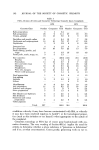
REGULATORY ACTIVITIES IN COSMETICS 105 ics could be radiation sterilized with safety. Now, it is well-known that ir- radiation of complex aqueous systems may cause many unpredictable chemi- cal changes including hydroxylation, dehalogenation, or rupture of aromatic rings. In order to get more specific information, we undertook a study of the effects of cobalt-60 irradiation on FD and C Red No. 3, the structure of which is shown in Fig. 2. Doses ranging from 0.2 up to 5.0 megarad (Mr) were used. The irradiated sample and an unirradiated control were analyzed side-by- side by means of the FDA column chromatography procedure which we use regularly for the certification analysis of Red No. 3 batches. After 30 minutes of development on a Solkafloc column, the control (unir- radiated Red No. 3 solution) showed a relatively homogeneous band of color moving down the column. By contrast, a sample of solution irradiated with 5 Mr showed both a new, faster component much farther down the column and a much slower component, of deep rose color, still at the top of the col- umn. More careful examination of the consecutive eluted fractions showed a half-dozen different color fractions in the irradiated solution. Table II summarizes the quantitative results on the destruction of Red No. 3 by irradiation, as calculated from spectrophotometry of the column frac- tions shown previously. A 5-Mr dose converted all of the Red No. 3 in a 0.1% solution into unknown fractions nothing measurable remained which has the absorption spectrum of the original tetraiodofiuorescein. At a dose of i Mr, about half of the Red No. 3 in a 0.1% solution is destroyed. However, for Red No. 3 in the solid state, a dose of 5 Mr causes only about 1% destruction. The results of this and related work, including irradiation of some other organic colors, did provide a portion of the scientific knowledge needed. We also have access to some physical and chemical tests on a sample of ferric oxide color additive before and after irradiation. But a large amount of fur- ther information must be obtained, regarding radiation effects on organic and inorganic color additives as well as on complex mixtures used in cos-

106 JOURNAL OF THE SOCIETY OF COSMETIC CHEMISTS Table II Irradiation of FD and C Red No. 3 Column Chromatography Fractions • Powder (as Received) 0.1% Solution 1% Soln Fraction Control 5 Mr Control 0.2 Mr 1.0 Mr 5 Mr 5 Mr First 2 First 2 All First 2 Unknown ......... and last and last and last 2,4,7-Triiodo- fiuorescein 0.06 0.05 ... 2.04 4.05 ...... 2,4,5-Triiodo- fiuorescein 2.66 2.55 2.77 3.81 6.3 ... 6.4 2,4,5,7-Tetraiodo- fiuorescein '85.5 84.5 85.3 72.5 36.6 ... 44.7 1.6 6.5 Totals of known fractions 88.2 87.1 88.1 78.2 48.6 0 57.6 "Figures given as percentages. metics, before it will be possible to make the transition from scientific knowl- edge to official action approving the safety of radiation sterilization. A third case in point is provided by the bubble baths. An overwhelming weight of evidence had accumulated to show that at least two popular brands of inexpensive bubble bath powders were causing large numbers of genito- urinary rashes, inflammations, and in some cases infections or other serious conditions, especially in young girls but in others as well. Animal testing did not appear to be a useful tool for prediction of this type of human adverse reaction. We made the hypothesis that the cause was the powerfnl detergent action of the alkylarylsulfonates which constituted about 35% by weight of the two brands of powder bubble bath involved the detergent action could cause removal of the normal oily protective secretions from the body surface, and open a pathway for inflammations or infections. It was of course not pos- sible to check this hypothesis by large-scale experiments on human children. Even so, the judgment was made to request the manufacturers to cut drasti- cally the percentage of alkylarylsulfonate used in their bubble baths. The number of bubble bath complaints was observed to drop after this reformula- tion, but there continue to be enough complaints to warrant some further consideration of this problem. A fourth and last example of the distance from scientific knowledge to regu- latory action is provided by asbestos in talcum powder cosmetics. There are certain facts which are well-established, as for example: A. Asbestos occurs in a half-dozen varieties, of which two, chrysotile and tremolite, are often found as natural contaminants in talc. (All three min- erals are magnesium silicates and may contain other elements as well. ) B. Asbestos workers exposed to inhalation of chrysotile asbestos fibers have a much higher risk of developing lung cancer and mesothelioma than the gen- eral population.
Purchased for the exclusive use of nofirst nolast (unknown)
From: SCC Media Library & Resource Center (library.scconline.org)