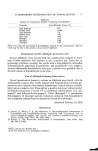
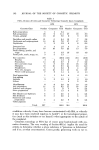
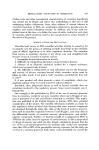
AMINO ACID DERIVATIVES AND ViTILIGO 65 Table I Inhibitory Effect on a Dopa-Melanocyte System }nhibitors Tyrosine and Related Products Tyrosino Tyramine p-Hydroxyphenylpropionic acid p-Hydroxyphenylpyruvie acid p-Hydroxycinnamic acid p-Hydroxyphenylacetic acid p-Hydroxymandelie acid p-Ethylphenol p-Ethoxyphenol (MEH) p-Hydroxybenzoic acid Methyl-p-hydroxybenzoate p-Hydroxybenzaldehyde p-Hydroxybenzyl alcohol Dopamine 3,4-Dihydroxyphenylpropionic acid 3,4-Dihydroxyphenylacetie acid Phenylpyruvic acid Adrenaline and Related Products Adrenaline Noradrenaline Adrenalone Synephrin© ø Veritol Ephedrine Pervitine© a Diln. Limit • Inhib. Effect • 1 0 1 o 1• + V8 ++ •A• +++ 1 0 1 0 % ++ •A• +++ 1 0 1 o 1 0 1 0 % + 1 o •A6 +++ 1 0 •A6 +++ 1 o 1 o 1 o 1 0 aRatio at which the activity of the inhibitor is still detectable, e.g., %: molar concentra- tion of inhibitor 8 times inferior to that of Dopa. b0 = nil, q- = weak, q-d- ---- fair, q-+q-: strong. CWinthrop Laboratories, New York, N.Y. •Temmler, Germany. phrine). In this category of substances, the inhibitory effect seems bound with the presence of two hydroxyphenolic groups and the substitution of the amino group (i.e., the effects of adrenaline, noradrenaline, adrenalone, syne- phrine). This can be seen in Fig. 1. If we take into account only the strongest inhibitors of the Dopa reaction found in this work, we can see that three of them correlate and strengthen the starting hypothesis. Indeed, p-hydroxyphenylpyruvic acid as well as p-hydroxycinnamic acid may be the result of a defect of the metabolism of tyrosine. However, the inhibitory effect of adrenaline in relation to the lack of the inhibitory power of noradrenaline may be of greatest significance. A few years ago, Shelley and Ohman (5) found that a simple injection of cpincphrinc in rats produced a spot of white hair at the site of injection. They concluded that intense vasoconstriction was the reason for this selec- tive damage of the melanocytes. But at the same time, the injection of nor-

66 JOURNAL OF THE SOCIETY OF COSMETIC CHEMISTS epinephrine did not produce the whitening of the rat hair. These results are too similar to ours not to make a correlation between them. ( Received February 14, 1973) REFERENCES (1) Brun, R., Contribution •t l'•tude de la d•pigmentation experimentale, Bull. lnst. Nat. Genevois, 61, 1-71 (1961). (2) Frenk, E., Experimentelle Depigmentierung der Meerschweinchenhaut, Arch. Klin. Exp. Dermatol., 235, 16-24 (1969). (3) Brun, R., Effect of the ethyl ether of hydroquinone on pigmentation and on the cells of Langerhans, Dermatologica, 134, 125-8 (1967). (4) Ijima, S., and Watanabe, K., Studies on Dopa-reaction, J. Invest. Dermatol., 26, 235-7 (1956), and 28, 1-4 (1957). (5) Shelley, W.-B., and Ohman, S., Epinephrine induction of white hair in ACI rats, Ibid., 53, 155-8 (1969).
Purchased for the exclusive use of nofirst nolast (unknown)
From: SCC Media Library & Resource Center (library.scconline.org)