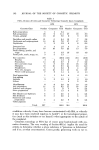
EFFICACY OF ANTIDANDRUFF FORMULATIONS 89 It is important to use strict diagnostic criteria in selecting the test panel. It is all too common for "antidandruff" assays to include patients with sebor- rheic dermatitis. This reflects the near universal belief that dandruff is mere- ly low-grade seborrheic dermatitis. As a rule, dermatologists do not clearly distinguish between the two and the literature is completely confusing. We shall elsewhere publish observations which argue strongly against the view that seborrheic dermatitis is a severe form of dandruff. The two condi- tions are quite unrelated. We pointed out in our first publication that parakeratotic loci were a his- tologic characteristic of dandruff (16). We now realize that this also occurs in persons without dandruff though to a lesser extent. By appropriately de- fatting and staining the corneocyte scrub sample one can identify nucleated cells and determine their proportion. This furnishes a simple objective means of distinguishing seborrheic dermatitis in difficult cases where the disease is limited to the scalp. It is inappropriate here to delve into details suffice it to say that nucleocytes (parakeratotic cells) commonly make up 15 to 25% of the corneocyte count in seborrheic dermatitis and rarely exceed 5% in dandruff. Goldschmidt et al. (8) have recently utilized exfoliative cytology to demon- strate the high prevalence of nucleated horny cells in seborrheic dermatitis. Unnecessarily complicated systems of clinical grading are an outgrowth of the notion that dandruff is unevenly distributed. The tactic employed to deal with this supposed geographic variability is to divide the scalp into segments each of which is separately scored a composite index of severity is then cal- culated. Van Abbe and Dean have exceeded all others in inspecting every portion of the scalp. Originally they rated 25 imaginary regions an examina- tion of one subiect took 30 min (4)! In a later "rapid" method, taking 5 min, only four areas were scored. Quite commonly the scalp is divided into 9 imaginary areas (14). We have abandoned all such approaches and form a single global estimate by throwing up some scurf in various sites with a tongue blade. This study has confirmed what has long been suspected, namely, a distinct seasonal variation in scalp scaling. Dandruff diminishes in the summer the frequency distributions by season showed an unmistakable increase in the higher grades in winter. We have long been aware that it is more difficult to recruit grade 5 subjects for studies in the summer. On the other hand, Van Abbe has not obtained evidence for seasonal rhythms of this kind (13). It is interesting that Orcntreich has detected a seasonal pattern in the rate of scalp hair shedding the loss is greatest in the fall (19). Still another misconception besets the appraisal of antidandruff prepara- tions. Laymen and physicians alike are persuaded that dandruff is a fluctua- ting process, subject to sudden swings in severity from week to week. The ex- traordinary oscillations in weekly grades portraycd by Van Abbe and Dean (4) for placebo-treated patients are alien to our experience. We consider

90 JOURNAL OF THE SOCIETY OF COSMETIC CHEMISTS dandruff to be a highly stable process with oscillations of a very low magni- tude. We rather think that the level of scaling is a steady state characteristic of an individual much as is hair growth or sebum output. Van Abbe and Dean have been so impressed with the fluctuating course of dandruff as to state: "It is essential to compare the progress of a treated panel with an untreated panel running concurrently" (4). This is simply not feasible. In our view, the fluctuations pertain to seborrheic dermatitis. That disease indeed does pur- sue an erratic course in which sudden exacerbations are a commonplace following emotional traumas, illness of various kinds, etc. The old saying of "getting one's dander up" applies to seborrheic dermatitis not to dandruff. In our experience the level of dandruff does not change appreciably from adult- hood to middle age. Dandruff does not spontaneously come and go. A "cure" is impossible. We have set rather strict time limits within which to judge antidandruff efficacy. Feasibility and economics are important considerations. In the hands of others, assays of shampoos entail about 2 months of treatment. Longer times are not unusual. A prolonged treatment period might result in a judge- ment of parity for two materials which were in fact different. After protracted use weaker agents may appear to be equally efficaeous in subjects with mild dandruff. As a practical consideration, an agent which has not given satisfac- tion after 3 weeks of use should not be esteemed. Products of established value become useful benchmarks for assessing comparative effectiveness. Our reference products are 2.5% selenium sulfide (Selsun Suspension) and 2% zinc pyrithione (Head and Shoulders) sham- poos. In contrast to Orentreich et al. (14) who could not distinguish between the two (minimum treatment of 6 weeks), we regard the former as more effec- tive. Improvement can be noted earlier, usually after the second shampoo, and the suppression of scaling is generally greater by 3 weeks. Perhaps par- ity could be achieved after 6 to 8 weeks of twice weekly shampooing. Since both products have been extensively used and have a known record of per- formance, these may serve as standards for rating novel formulations. If one has a data base it may not be necessary each time to run the reference ma- terial concomitantly. Half-scalp applications have been utilized to compare two materials on the same individual (20). Paired comparison tests are in fact extensively used in evaluating topical therapies for skin disorders. While admirable in princi- ple, we have shown that a drug which is very active in small amounts may be surprisingly effective at a site far removed from the area of application (21). Thus, neomycin cream to one side or even one area, may decimate the Staphylococcus aureus population of dermatitic skin in untreated, distant sites. Translocation of the drug is responsible for this behavior. We have ob- served the very same phenomenon on the scalp. We applied a 1% aqueous
Purchased for the exclusive use of nofirst nolast (unknown)
From: SCC Media Library & Resource Center (library.scconline.org)