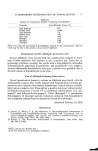
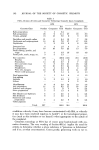
AMINO ACID DERIVATIVES AND VITILIGO 63 5.10 -a mole/ml Dopa 1/1 corresponding to 5.10 -• mole/ml inhibitor 5.10 -• mole/ml Dopa 1/• 2 corresponding to 0.156 10 -a mole/ml inhibitor The dilutions were made in a buffered phosphate solution (Soerensen) of pH 7.35 with traces of copper sulphate. The pH is adiusted, if necessary, after the addition of the inhibitor. For testing, the standardized tissue used was the nipple of the male col- ored guinea pig. Verification was also made with normal human skin. The reaction is performed on slides in damp boxes incubation time is 2% hours at 37øC. It is important to test pure chemical substances and not the pharmaceuti- cal forms of these products because of the common presence in the latter of preservative agents which can interfere with the Dopa-reaction. RESULTS AND DISCUSSION It must be emphasized that the method of Iiima and Watanabe (4) is not recommended in the study of all inhibitors of melanogenesis but, after our experiences, we have found it to be adequate and to give accurate results with competitive inhibitors. The results are shown in Table I. Derivatives o• Tyrosine and L-Dopa It was found that MEH, which is very active in vivo, is already an inhibi- tor at a molecular concentration •5• of that of Dopa. Moreover, we have been able to show that two substances which are derivatives of tyrosine present an inhibitory activity of the same order (•A• and %). These substances are p-hydroxycinnamic acid and p-hydroxyphenylpyruvic acid. It is conceivable that under the influence of a pathological phenomenon (to be determined) these degradation products of tyrosine could be liberated at the level of the melanocytes. In this aromatic amino acid family, the presence of one or two hydroxy- phenolic groups does not seem to play an important role in inhibitory activ- ity. On the other hand, as long as the molecule possesses a free amino func- tion no inhibitory effect could be found. Epinephrine and Derivatives The substances of this family are also either physiological or chemical derivatives of tyrosine and Dopa. The results found in this group are very surprising in view of the strong inhibitory action of adrenaline (epinephrine) in comparison with the complete inactivity of noradrenaline (norepine-

64 JOURNAL OF THE SOCIETY OF COSMETIC CHEMISTS
Purchased for the exclusive use of nofirst nolast (unknown)
From: SCC Media Library & Resource Center (library.scconline.org)