REGULATORY ACTIVITIES IN COSMETICS 107 C. The U.S. Occupational Safety and Health Administration has estab- lished an upper limit of 5 asbestos fibers per ml of inhaled air for a 40-hour workweek of occupational exposure this applies only to fibers longer than 5/•. The limit is scheduled to be cut down from 5 to 2 fibers per ml of air in 1.970. D. No single analytical technique is entirely satisfactory for the determina- tion of small amounts of asbestos in talc, at levels of 1% or less. Among the techniques which have been used are X-ray diffraction, optical microscopy, differential thermal analysis, electron microscopy, and electron diffraction, but the results are not always in agreement. Additional relevant facts could be listed, but it is interesting also to note the large number of scientific questions for which answers are not yet avail- able, such as: 1. Is tremolite asbestos as hazardous to inhale as chrysotile asbestos? 2. Can asbestos fibers shorter than 5 g be ignored as a biological hazard? 3. Are nonasbestos fibers, such as glass wool, equally capable of causing lung cancer? 4. How many asbestos fibers will be inhaled as a result of each normal application of a talcum powder containing, for example, 1% of asbestos as a natural contaminant? 5. In samples which contain mineralogical species that are intermediate or transitional between talc and asbestos, what degree of biological hazard and regulatory sanctions should be associated with the transitional species? In the face of such gaps in scientific knowledge, it is not easy to write a regulation which will apply a simple, straightforward analytical procedure to screen out those talcum powder cosmetics which contain asbestos in detecta- ble and hazardous amounts, and thus provide the full measure of protection needed by the consuming public without imposing impossible constraints on industry. Even though this task is not easy, it is one which faces us at present and cannot be avoided. In approaching it, we must make use of the best pos- sible scientific knowledge and judgments. That is the essence of our scientific activities in cosmetics at FDA, and the key to whatever success we hope to achieve: namely, to develop and maintain the best possible scientific knowl- edge and judgments. (Received May 25, 1,973) REFERENCES (1) Newburger, S. H., A Manual o[ Cosmetic Anahjsis, Association of Official Analytical Chemists, P.O. Box 540, Washington, D.C. 20044, 1962. (2) Belman, S., The fiuorimetric determination of formaldehyde, Anal. Chim. Acta., 29, 120-6 (1963). (3) Wilson, C. H., Flm•rometric determination of formaldehyde in cosmetic products, J. Soc. Cosmet. Chem., 25, 67-71 (1974). (4) Draize, J. H., and Kelley, E. A., Surface-active agents and the eye, Drug Cosmet. Ind., 71, 36-7, 118-20 (1952).

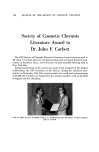
108 JOURNAL OF THE SOCIETY OF COSMETIC CHEMISTS Society of Cosmetic Chemists Literature Award to Dr. John F. Corbett The 1973 Society of Cosmetic Chemists Literature Award was presented to Dr. John F. Corbett, Director of Chemical Research at Clairol Research Lab- oratory in Stamford, Conn., at the Society's Annual Scientific Meeting held in New York City. Formal presentation of the award was made to Dr. Corbett by Mr. Robert Goldemberg, the 1973 President of the Society, during the luncheon cere- monies on December 11th. The award consists of a scroll and an honorarium of $1,500. Dr. Corbett was honored for his original research work in the field of organic and dye chemistry. Left to right: Society President Robert L. Goldemberg and Literature Award recipient John F. Corbett
Purchased for the exclusive use of nofirst nolast (unknown)
From: SCC Media Library & Resource Center (library.scconline.org)