RATIONALE OF ODOR CLASSIFICATION 17 with only a relatively few kinds of nerves, and these used in permuta- tions and combinations to convey in- formation about the presence of any kind of odor detected. The first pattern corresponds to a telephone network, with a separate line to central for each odor, and the second corresponds to a coded message, capable of being unscrambled at the interpretation center. The so-called "principle of parsi- mony," which applies to all of the other activities of the human body, does not permit great numbers of parts to stand by idle most of the time, to be used only on occasion. Indeed, muscles, bones, or nerves must be in frequent activity in order to develop at all and to be trained to function when stimulated. With this principle of parsimony in mind, we are forced to conclude that odor impression transmission prac- tically must take place over a com- paratively limited network of kinds of nerves, frequently used. This is only another way of saying that components of some sort must exist in odor sensation, and that it should be possible to classify odors by a method based on these components. The Crocker-Henderson system of odor classification was devised some 23 years ago, and has had considerable publicity. We shall consider it alone, although we recog- nize that other systems are con- ceivable. It was developed by cut- and-try methods, working with ac- tual odor sensations, to find com- ponents if they exist, keeping the principle of parsimony definitely in mind. In its present form, it recognizes only four basic types of odor sensation as applying to the human nose--fragrance, acidity, burntness, and caprylicness. It ex- presses all pure odor sensations as composed of these four component sensations, denoting the relative intensities of each by single digits, arranged in a particular sequence: that based on general human in- terest. The digits ordinarily used are 1 to 8, but conceivably 0 to 9 can be so used, for extreme cases. Each of the four sensation com- ponents is considered capable of appreciation independently of the others. The sense of smell is sup- posed to be analytical enough and critical enough that we can concen- trate on these components one at a time. Some workers are able to analyze their sensations very well, but apparently all can do so with some facility. Physically, this system uses a set of 32 standard substances which have been selected as being reason- ably stable against changes with time, and harmless and non-tiring, one for each originally recognized degree of differentiation for each of the four components. Some of the standards are easier to work with than others, being predominant in the component for which they are standards, while others leave some- thing to be desired. With such a set of odor component standards, any odor sensation may be "odor- numbered" by direct comparison with the standards, one component at a time, to obtain a 4-digit number

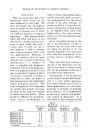
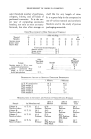
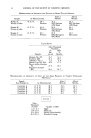
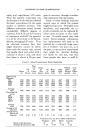
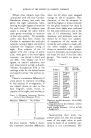
18 JOURNAL OF THE SOCIETY OF COSMETIC CHEMISTS which is the code number for that sensation, as 7733 for citral and 7535 for linalool. By this means and using only whole numbers, some 8 X 8 X 8 X 8, or 4096, separate sensations may be dif- ferentiated and expressed: not nearly enough to cover all known odors, but a usefully sizeable group. With this arrangement or system, odors are detected subjectively, but may be compared with other sub- jective impressions, obtainable at will from standard objective sub- stances. It should be pointed out here that this system can deal only with single pure odor sensations which remain the same for at least a period of time during evaporation. Most flower odors and commercial per- fumes are characteristically never twice alike: they vary with time as successive ingredients evaporate, these ingredients being of different volatility, diffusibility, and to some extent of different relative solubility in water and lipids, and also different in odor. Each of the various in- gredients of such a complex odor can be odor-numbered separately, or a general-average odor number of the whole can be arrived at for top notes or other particular stages of the evaporation. With these limitations and possi- bilities in mind, how closely can the Crocker-Henderson system define single pure odors, how well do people check each others' findings, and how much training is needed to use the system effectively? Although the reliability of this system has been tested before, for some of these matters, a test was run in our flavor laboratory recently, unknown to the speaker and in his absence, to an- swer all of these questions at one time. The findings obtained may be of general interest. Four of the observers tested were trained flavor workers and had used the Crocker- Henderson system before, at least occasionally, but the other four were persons who were odor-numbering for the first time. Each observer was tested on eight assorted sub- stances: geraniol, oil of cloves, tincture of castoreum, geranyl pro- pionate, oil of anise, benzaldehyde, aldehyde C-9, and phenylethyl phenylacetate. The substances were issued to the observers, one at a time, for numbering. Never more than three were done at one sitting. The observers worked alone, with a set of standards and a sheet of instructions. All determined the odor numbers, totalling 64, each of four digits, and the findings were then analyzed for variance, contrasting particu- larly the work of the experienced and the inexperienced observers. The experienced workers did not do much better than the inex- perienced as might have been ex- pected, showing an average vari- ance of 0.96 unit from the general average for each digit determined whereas the inexperienced observers varied by 1.17 units from the aver- age, which was 20 per cent greater variation (see Chart 1). The aver- age variances for the four com- ponents were: fragrance 1.05 units, acidity 0.95 unit, burntness 1.03
Purchased for the exclusive use of nofirst nolast (unknown)
From: SCC Media Library & Resource Center (library.scconline.org)