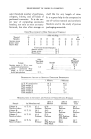
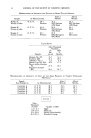
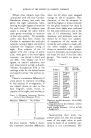
RATIONALE OF ODOR CLASSIFICATION 19 units, and caprylicness 1.25 units. Thus the caprylic component was the hardest to work with and showed the least concordance for the same worker or between workers. The different substances tested showed considerably different degrees of variance, from 0.78 unit for tincture of castoreum and 0.87 for geraniol to 1.41 for oil of anise or for benzal- dehyde, averaging 1.07units. Thus we obtained answers, first that single observers cannot do better than reach the nearest unit, second that people check each other with a variance of about 1 unit, and third that there is about a 20 per cent gain in accuracy through consider- able experience with the system. Study of these findings indicates several ways in which the system might be improved. Probably some standards, and especially the ca- prylic standards, can be replaced by others more accurate or else easier to use. A careful search may find many better-adapted substances, but replacements will need to be checked by a relatively large num- ber of workers--not just two, as in the past, no matter how experienced they might be. Another finding, not shown by this test, was that those people who have to sniff 15 CHAKT I•DoR-NuMBERING BY EIGHT OBSERVERS Geran- iol ture Geran- Phenyl- Aver- Oil of iol Oil Benz. Aide- ethyl age of Casto- Pro- of alde- hyde Phenyl- Devia- Cloves reum pionate Anise hyde C-9 acetate tion Experienced Observer: ND RMP ELR VES 7334 5484 3457 3745 6542 7473 4477 4245 0.82 7442 5373 4365 6244 6433 5372 6721 7244 0.97 7342 5474 3667 4423 7433 8324 3456 2333 1.10 7465 6685 4684 5446 5523 8484 5564 5545 0.97 Average value 7443 5484 4566 First-time Ob- server: JFA 8435 7566 3566 PEM 6532 5373 4357 AJN 5345 7453 5565 MTW 7732 7652 4356 Average value 7534 7564 4466 Average of all observers 7443 6474 4466 Average devia- tion for all observers 0.87 0.94 0.78 Totals of all deviations Average deviation per digit 5445 6533 7463 5555 5344 0.96 6556 6466 7665 3346 3425 1.00 3528 8251 2375 2638 7254 1.35 6654 7367 8476 6435 7536 1.22 3652 4534 6525 4455 4243 1.12 5645 6455 6565 4446 5345 1.17 5545 6444 6464 4545 5344 1.07 1.19 1.41 1.41 1.28 1.10 1.07 VARIANCES FOR THE Four ODOR COMPONENTS Fragrant Acid Burnt Capry[ic 67 61 66 80 1.05 0.95 1.03 1.25

20 JOURNAL OF THE SOCIEYY OF COSMETIC CHEMISTS or 20 cc. of air in order to detect any odor attain far less accuracy in odor-numbering than do those whose noses detect odor with only $ cc. of inspired scented air, as shown by the Elsberg apparatus. Perhaps larger containers than the small test tubes now in use for the stand- ards would favor accuracy by pro- viding more scented air for the hard-of-snifFing who still may have good odor detection if enough quantity reaches the smelling area. This system of odor classification is primarily useful as a training de- vice for beginners in odor. It teaches them to concentrate and to analyze their sensations. Some- times, it provides alternatives for particular odorants. In any event, by the time we have determined the odor number of a substance, we already have become reasonably familiar with its odor and have com- pared it with other odors. If an odor-detecting machine is developed which has good inherent discrimina- tion, it will be of very great interest to compare its findings with those of this system, particularly to find out what the machine misses of what we smell, and vice-versa. For the pres- ent, we suggest that use be made of this admittedly imperfect tool. Contributions by others to improve the system are solicited and will be welcome. It suggests certain things that are possibly inherent in odor, hence should be useful in the search for the truth about odor. It is intended to be a light in com- parative darkness--a weak light perhaps, and flickering--but at least, a light.
Purchased for the exclusive use of nofirst nolast (unknown)
From: SCC Media Library & Resource Center (library.scconline.org)