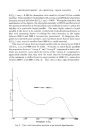
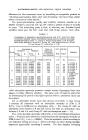
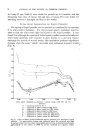
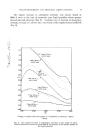
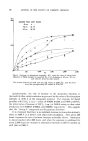
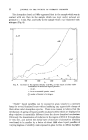
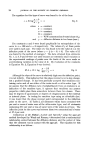
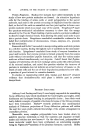
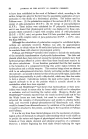
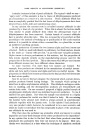
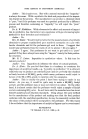
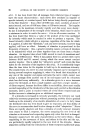
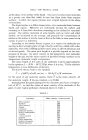
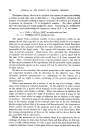
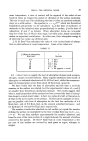
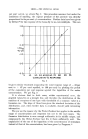
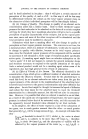
l0 JOURNAL OF THE SOCIETY OF COSMETIC CHEMISTS 0.05 DISTANCE FROM LIGHT SOURCE 45 cm. . X. 90 •m. © (• 135 c• [] [] 500 1,000 hrs. 1,500 2,0•00 2,500 Fig. 6. Increase in absorption intensity, AE, with the time of ultra-violet exposure of three samples of material No. 8 at distances of 45 cm., 90 cm., and 135 cm. from the light source. The crosses indicate in each case the Alg values at 2490 ]iU., and the dots show the corresponding Alg values at 2710 Quantitatively, the rate of increase of the absorption intensity as the result of ultra-violet irradiation is governed by the value of the absorption intensity at 2710 A of the unexposed material. For example, for liquid paraffins with E(1%, 1 cm.)-- values of 0'0058, 0-0268, and 0.049 at 2710 A, the initial rates of increase of E(1%, 1 cm.) at 2490 A owing to ultra-violet irradiation were 0'00015, 0.00043, and 0.00062, respectively. This suggests that the "Group A" compounds are the primary absorbers. It is of interest that there is no indefinite increase in absorption intensity either at 2490 A or at 2710 A with ultra-violet irradiation. After about 200 hours' exposure the rate of increase becomes noticeably slower. Saturation is almost reached after 800 hours, and when the exposure is continued for about 2,500 hours the increase in absorption intensity at 2710 • catches up with that at 2490 A.

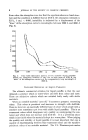
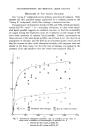
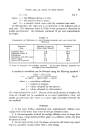
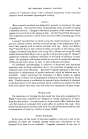
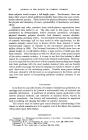
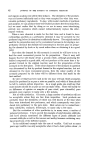
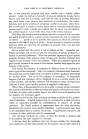
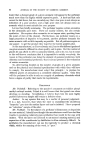
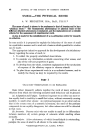
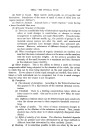
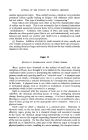
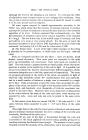
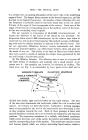
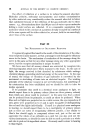
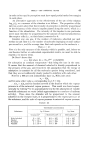
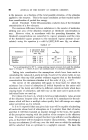
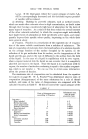
SPECTROPHOTOMETRY AND MEDICINAL LIQUID PARAFFIN l l MECHANISM OF THE AGEING REACTION The "Group A" compounds are the primary absorbers of radiation. They transfer the thus acquired energy apparently by a collision process to the "Group B" compounds, which then undergo a chemical reaction. The appearance of absorption bands at 2.85/• and 5.85/• (which are charac- teristic for OH-- and C: O-- stretching vibrations) in ultra-violet irradi- ated liquid paraffin suggests an oxidation reaction, so that the availability of oxygen during the irradiation must be of influence on the change of the ultra-violet spectrum of exposed liquid paraffin. Indeed, experiments on three portions of the same liquid paraffin, one of them in air, the other in an atmosphere of nitrogen, and the third in an evacuated quartz vessel, proved that the increase in ultra-violet absorption intensity with exposure time was similar in the three cases, but that the rate of increase was largest in the presence of air and smallest when the vessel was evacuated (Fig. 7). olo oo A[ x x x/• ••• o o r4 •) o o o o• Quartz vessel evacuated I & II I 500 !,000 !,500 2,000 2,500 t•rs Fiõ. 7. Increase in absorption intensity, AE, as function o• the ti•e of ultra-violet irradiation o• three samples o[ material •o. 9, x denotes the AE values at 2490 J•O. ß denotes the AE values at 2710 J•U.
Purchased for the exclusive use of nofirst nolast (unknown)
From: SCC Media Library & Resource Center (library.scconline.org)