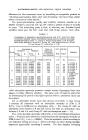
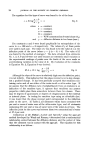
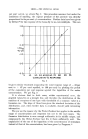
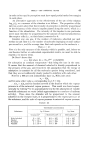
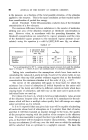
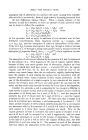
14 JOURNAL OF THE SOCIETY OF COSMETIC CHEMISTS producing an additional amount of unsaturated molecules, and hence dis- coloration by virtue of adding to the sulphonated products. There is spectrophotometric support for this view of dehydrogenation of naphthenic hydrocarbons by the acid used for the test. A very highly purified liquid paraffin of an absorption intensity E(1%, 1 cm.)= 0.0021 at 2700 21, had a low acid number •vhen examined with 96 per cent sulphuric acid, and there was very little increase in colour with time. When the test was repeated with 97 per cent sulphuric acid the same was true up to the twelfth minute of the reaction, but then a breakdown occurred and the colour increased considerably during the fourteenth nfinute. Twelve samples, of widely differing stability by spectrophotometric evidence, were subjected to the sulphuric acid test, and it was found that the acid number bore very little relation to the spectrophotometric stability of the liquid paraffin. TABLE 2 COMPARISON OF STABILITY AS ESTIMATED SPECTROPHOTOMETRICALLY WITH ACID NUMBER Sample 96 % 1t2SO 4 -keT7 Yellow 1.3 • 3.3 / 1.s / 3-6 1.0 ,• 2.3 1-4 2-7 2.3 5-5 0.9 2-0 2-1 5.3 1.0 2.3 1-3 3-2 1.8 4.3 97 % It•,SO4 Red Yello•v --5 Ys- 2.3 5.2 2.6 7.4 2-8 7.4 0.9 2.1 2-4 6.7 2.8 7.4 1.3 2-5 3.6 9-8 1.8 4.2 2.1 5.0 2-7 6-6 Spectro- photometric Absorption Ratio 1-75 1-85 2.15 2.57 1'48 1 '69 2'67 1 '56 1.94 Spectro- photometrically Estimated Stability Poor-Good Good Very Good Very Good Excellent Very Poor Poor Excellent Excellent Excellent Poor Good It so happens that three of the very stable materials, E, H, and J, have good acid numbers, whereas Sample I would be dismissed as unstable, cer- tainly when 97 per cent acid had been used for the test. On the whole, good and bad acid numbers are distributed quite haphazardly between stable and unstable oils. Further experimental evidence for dehydrogenation was obtained when the bulk of the "Group A" and "Group B" compounds was removed from nine samples of liquid paraffin, all of which showed after this a very low absorption intensity of the order of E(1%, 1 cm.)= 0.003 at about 2700 A, and in all but two of these samples band structure was completely absent. This means that these oils were free from all but minute traces of contaminating

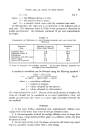
SPECTROPHOTOMETRY AND MEDICINAL LIQUID PARAFFIN 15 compounds. The other two samples contained only very small amounts of the undesirable materials, but when any of these oils are tested by the British Pharmacopceia Acid Test one would expect a very low value of the acid number, since by spectrophotometric evidence the amount of unsaturated hydrocarbons present would be very small indeed. The fact of the matter is, however, that the acid numbers vary between 0.9 Red and 1.7 Red and that in particular Sample Q (Table 3) which has a very low absorption intensity shows the highest acid number. TABLE 8 A½ii) NUMBERS OF EXTREMELY PURE LIQUID PARAFFINS Sample E H M N o P R 96% H•S0• Red Yellow 1-0 2.3 0.9 2.0 1.0 2.3 1-2 3.2 0.9 2.1 1.4 4.5 1.1 3-3 1.7 4-2 1.3 3.2 For a content of approximately 0-1 per cent of hydroaromatics, 0-0022 grammes of sulphuric acid would be needed to complete the sulphonation reaction. The actual xveight of 96 per cent acid used for the B.P. test is 8.83 grammes, and this means that an overwhelming proportion of sulphuric acid is free to act on the naphthene-paraffin molecules of the liquid paraffin after all the hydroaromatic molecules have been sulphonated. It is true that there are samples of liquid paraffin xvhose content of hydroaromatics is five or six times the average figure, but even so the quantity of acid required for the sulphonation would be just below 0.014 grammes, as compared with the 8.83 grammes available. DISCUSSION The ultra-violet absorption spectrum of medicinal liquid paraffin in the wavelength region between 2400 A and 2800 A shows the wide difference in quality of materials which the B.P. Acid Test passes as satisfactory. The B.P. acid number is supposed to indicate the amount of carbonisable bodies present in a medicinal liquid paraffin, and to reject those samples for which the proportion of these carbonisable substances is above an arbitrarily fixed limit. No definition of carbonisable materials is given, but if they are taken to be synonymous with the contaminating compounds whose presence is detected by the band structure appearing in the near ultra-violet absorp-
Purchased for the exclusive use of nofirst nolast (unknown)
From: SCC Media Library & Resource Center (library.scconline.org)