50 JOURNAL OF THE SOCIETY OF COSMETIC CHEMISTS of it. It has been found that all messages from whatever type of receptor have the same characteristics: each nerve fibre conducts an impulse of specific intensity at constant speed, both factors being directly proportional to the fibre diameter: thus a fibre of 0.001 mm. diam. conducts at about 5 metre/second, and one of 0.02 mm. diam. at 120 metre/second. The impulse builds up to its maximum intensity rapidly and dies away more slowly: its size is independent of the strength of the stimulus, which must be above a minimum in order to excite the nerve: it is an all-or-none reaction. It has been found that there is a value of the product of the time multiplied by intensity which must be reached in order to produce a response. The lowest intensity which •511 give a response, regardless of the time for which it is applied, is called the "threshold," and any lower intensity, however long applied, will have no effect. Intensity of stimulus is proportional to the frequency of impulse: thus, a greater stimulus causes a stream of impulses to be transmitted which are closer together than are those from a weaker stimulus. An impulse takes about 0.001 second to reach its maximum and lasts about 0-002 second. When it has passed, there is a period which varies between 0.015 and 0.1 second, during which the nerve cannot conduct another impulse: this is called the "refractory period" and covers the time taken for the intensity of the impulse to die away. It is considerably longer than the time taken for the impulse to build up to its maximum intensity. The sensitiveness of a nerve to a low intensity response can be increased by having several receptors supplying it, when it is found that stimulation of any one of the receptor end-organs activates the nerve which cannot now accept a message from another one of its end-organs until its refractory state has died away sufficiently. As a stimulus given to a nerve increases above the threshold, at first a small number--and then a larger number-- of fibres respond, because the fibres differ in excitability, those most readily excited responding at the threshold and the less easily excited as the stimulus increases, until a point is reached where all of the fibres respond and any further increase in stimulus gives no additional response. If a stimulus is increased in intensity gradually, the intensity can reach relatively enormous proportions without promoting activity (thus a gradual build-up in the intensity of an electric stimulation of a nerve to forty times the threshold value has been found to give no response), and thus ability of the nerve to accommodate itself to slow change is called "adaptation." Nerve fibres are rapidly adapted, and thus a stimulus of nearly constant intensity soon ceases to elicit a response, the nerve accepting the new level of the stimulus as its normal and responding again only when this level is changed. Receptor organs have the same characteristics as the nerve fibres those responding to the movement of hairs, and others in the skin and the eye, are particularly rapidly adapted to the new level of the stimulus. Hence sensations arising from the stimulation of these receptors rapidly fade away

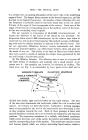
SMELL--THE PHYSICAL SENSE 51 although the level of the stimulus is not altered. To overcome the effect of adaptation, some receptors move so as to enlarge their usefulness thus, the eye has a constant motion with a frequency of about 0-1 second to enable it to be more precise and less adapted. All sense organs respond to stimuli approximately according to the Weber law, which states that the increase of stimulus required to produce a perceptible increase in sensation is always the same fraction of the sensation regardless of its level. Fechner expressed this mathematically--i.e., that the perception of sensation varies as the natural logarithm of the stimulus R ---- alog,S. This law is true only in the middle range of intensity and does not hold for very weak or very strong stimuli. For the sense of touch the fractional increment is about 1/10 to 1/40, depending on the part of the body concerned--for hearing 1/9 to 1/20, and for vision about 1/160. (b) The Visual Sense. A part of the light which impinges on the retina is absorbed by its photo-receptors, of which there are two types: rods and cones. Rods are elongated cylinders like fine fibres cones are shorter, much thicker, conical structures. Their inner parts are connected to the optic nerve via intermediate cell connections their outer parts are sensitive to light. The rods contain a pigment known as visual purple, whose absorption spectrum is similar to the sensitivity of the rods to light. It is possible, but not proved conclusively, that the cones have three different pigments, whose maximum absorption are in the blue, green and red respectively. The cones are grouped principally in the centre of the retina, are sensitive to light of relatively high intensities (about 10 -• candles/square foot and upwards), and in a small number of instances a single cone is connected to a single nerve fibre. Rods are grouped around the cones, thus occupying the peri- phery of the retina, are sensitive to light of low intensity (below 10 -4 candles/ square foot), and hundreds---even thousands---of rods are sometimes con- nected to one nerve fibre. However, there is no sharp line of demarcation in the retina between the areas of the rods and cones, cones existing sur- rounded by rods cones and rods can even be joined to the same nerve fibre. In the human retina there are around 110/125 x 106 rods and 6.5 x 10 ß cones, between them connected to some 1 x 10⁶ nerve fibres of the optic nerve. When light falls on the rods, the visual purple is bleached, and subsequent physico-chemical reactions stimulate the nerve endings of the rod cells and,. eventually, the fibres of the optic nerve. Around 90 per cent of the light is transmitted through the rods and is absorbed in the black pigments behind the retina, possibly giving rise to reactions renewing the bleached visual purple. The amount of visual purple bleached controls the intensity of the stimulation, and it has been found that
Purchased for the exclusive use of nofirst nolast (unknown)
From: SCC Media Library & Resource Center (library.scconline.org)