JOURNAL OF THE SOCIETY OF COSMET1C CHEMISTS 5-14 quanta of light is the intensity threshold for the rods. Light of any particular wave length affects rods only in proportion to its intensity and to the degree to which they absorb light of that wave length. There is thus no qualitative response in a manner specific to the wave length, and rods-- being all of one sort---cannot give rise to the sensation o! colour. The essential receptor function is the absorption by a pigment of light quanta with consequent chemical change, resulting in transmission of an mpulse along the optic nerve. (c) The Auditory Sense. The ear consists of the external ear, the middle ear and the inner ear. The function of the first is to collect the sound that of the second, bounded externally by the drum of the ear and containing a bone lever mechanism, is to magnify the sound, this magnification amount- ing to about ten times after allowing for loss of energy to the magnifying lever system. The inner ear is the receptor mechanism of the auditory nerve endings, and this is our immediate interest. It consists of two structures--the "vestibule," concerned with maintenance of equilibrium, and the "cochlea," which is a tube filled with liquid, the "endolymph," 20-30 mm. long, wound spirally around a cone of bone from which a spiral lamina of bone extends about two-thirds across the tube. From the outer edge of this lamina, two membranes extend to the walls of the tube, thus forming three ducts through- out its length. These membranes differ in structure: the basal, called the "basilar membrane," has attached to it the "organ of Corti." The organ of Corti consists of a double row of stiff cells, the inner and outer rods of Corti, which are surrounded on the inner side by a single row, and on the outer by three rows, of hair cells. The fibres of the auditory nerve end in aborisa- tions among these two sets of hair cells. Between the hair cells are the cells of Deiters, whose peripheral processes join together to form a membrane (membrana reticularis) over the hair cells through which the hairs protrude. Resting on top of the membrana reticularis is a membrane (membrana tectoria) projecting from the upper edge of the spiral lamina. In man there are about 24,000 hair fibres, ranging in length from 64 to 128 t• at the base of the cochlea, and from 352 to 480 t• at the apex. There are some 80,000 nerve fibres serving the organ of Corti. A positive pressure sound wave on the drum results in movement of the endolymph in the cochlea, which causes Reissner's membrane to move downwards consequently the basilar membrane is forced downwards and the hair cells are drawn further away from the membrana tectoria. Similarly, a negative pressure wave draws the hair cells closer to the membrana tectoria, which possibly has a damping effect on their movement. There have been many theories of hearing, most of the very considerable body of evidence supporting Helmholtz's theory of resonance. This is simply that the different hair fibres of the basilar membrane each vibrate

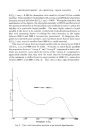
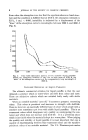
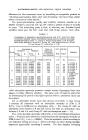
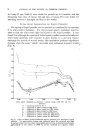
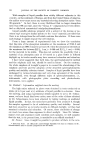
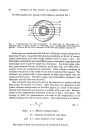
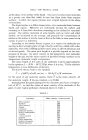
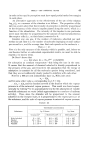
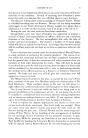
SMELL--THE PHYSICAL SENSE 53 to a certain note, so causing stimulation of the nerve cells of the underlying organ of Corti. The largest fibres resonate to the lowest frequencies, and the shortest to the highest frequencies ß the number of hairs vibrating with any one frequency is probably small (it has been found that in the cat about 2.5 mm. of the organ of Corti corresponds to the octave). Each area of the organ ol Corti has its corresponding area in the auditory centre of the brain, in this way resembling visual response. The ear responds to frequencies of 40-40,000 vibrations/second. It locates the direction of the source of the sound by two processes' for frequencies below about 1,000 vibrations/sec. by the relative time taken to reach each ear, but at about this frequency this method becomes of diminish- ing value and the relative intensity at each ear is the effective factor. The ear can appreciate differences between various instruments and, when several are sounded together, can differentiate between them and pick out the sound of any one. This ability is the basis of Ohm's law (which states that every sound is capable of analysis into simple tones appreciated by the ear and having a characteristic pitch). (d) The Olfactory Receptor. The olfactory area in man is a by-pass off the main stream of inhalation, and normally only a small amount of air passes over it' this quantity can, however, be increased by sniffing. The nasal area--see Fig. 1--is surrounded by bony parts of the skull and is -•UI•ERIOR TURBINATE OLFACTORY MEM3RANE Fig. 1 ßvided into similar right and left halves by the nasal septurn. The base of the area runs do•wards and backwards, whilst the roof is arched and na•ow. In between are three flat bones, "turbinates," for•ng passages more or less parallel to the roof of the n•al cavity and decreasing in size as they pro•ess towards the roof. Each of these passages is lined with mucous membrane of which there are t•vo •nds: the respiratory and olfacto• portions. The respiratory membrane is a red•sh, well-defined membrane which covers the lower part of the cavity, the •ferior and •ddle turbinates and the corresponding areas of the septurn. This membrane contains serous and mucous glands which are always generating liquid matter, which is
Purchased for the exclusive use of nofirst nolast (unknown)
From: SCC Media Library & Resource Center (library.scconline.org)