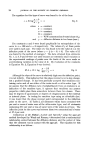
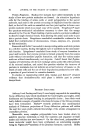
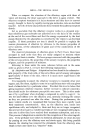
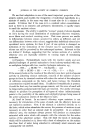
56 JOURNAL OF THE SOCIETY OF COSMETIC CHEMISTS The kinetic theory allows us to cMculate the number of molecules striking a surface in unit time, and we find that n: Np/v'(2•rMRT ), where n is the number of molecules striking a square centimetre of a surface per second, p is pressure in dynes/cm. •', N is Avogadro's number: the other symbols have the meanings previously assigned to them. Converting p to millimetres of mercury and substituting the numerical values of N, rr, R, we obtain n = (3'52 x 10•.•)p/x,/(MT ) in molecules/cm. 2/sec. or n = O'O583pV'(M/T) grams/cm.2/sec. The vapour from a perfume consists of many substances which we can assume do not react together, as any molecules which would do so in vapour form can be presumed to have done so in the liquid from which they have evaporated, since physical conditions for such reactions are so much more favourable in the liquid state. The vapour will therefore obey Dalton's "law of partial pressures," which states that--provided the temperature is constant--the pressure of a mixture of yapours in a given space will be the sum of the pressures which each would have if it alone occupied the space. Thus, a perfume should have a vapour pressure equal to the sum of all the vapour pressures of the ingredients, and the saturated vapour pressure of each molecular species in the vapour will not be altered by the presence of other species. We have so far considered the intrinsic properties of the vapour and have not concerned ourselves with its detection by the olfactory area. This obviously involves condensation--i.e., adsorption--of the vapour on a surface, and we ought to know something of the general properties of adsorbed gases. When a gas molecule hits a surface, it can do one of two things: either stay on the surface or rebound elastically. In the majority of cases it stays on the surface for a period which depends on the nature of the particular piece of surface with which it collides. When the molecule is reflected, the angie of reflection equals the angie of incidence, but when it stays on the surface for a short while the angie of reflection has no relation to the angle of incidence. The time it stays on the surface is determined by many factors, such as the kinetic energy of the molecule (this will be its own individual kinetic energy and not that of the mean of all the molecules), the temperature of the surface, the nature of the molecule and of the surface, etc. If the molecules stay on the surface for a time {even for a very short time), then the average concentration of them on the surface will be above that in the gas, and there will be adsorption. Whilst the molecules are on the surface, there is an opportunity for an exchange of energy to take place between them and the surface (in this way a hot, or cold, surface warms, or cools, a gas), and it has been found that for complete exchange of heat to take place between them, so that both have the

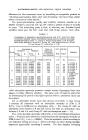
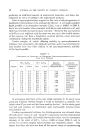
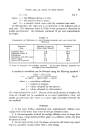
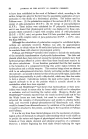
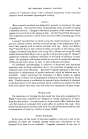
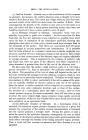
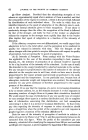
SMELL--THE PHYSICAL SENSE 57 same temperature, a time of contact will be required of the order of one hundred times (or longer) the period of vibration of .the surface molecules. This can be made use of in calculating the time (,) that an adsorbed molecule stays on a solid surface: the equation is ß: %.eOlRr which has theoretical foundations and permits ß to be calculated. ('o is the time of oscillation of molecules in the adsorbed state perpendicularly to surface, Q is the heat of adsorption, R and T as before). When adsorption forces are non-polar they are of the Van de Waal's force type, but when polar, dipole interaction makes an important contribution. In either case, their adsorption energy is of relatively low order, say 20 Kcal./mol. J. H. de Boer xø has calculated the value of ß for various heats of adsorp- tion on solid surfaces at room temperature. Some of his values are: TABLE II Q (Heat of Adsorption) Kcal./tool. 3.5 4 10 15 20 25 Seconds 4 X I0 -n 1 x 10 -•ø 3-2 x 10 -s 1.8 x 10 -2 1.0 x 10 2 6 X 10 5 (approx. a week) 3'5 --4 Kcal./mol. is roughly the heat of adsorption of gases such as argon, nitrogen, oxygen on solid surfaces. Many organic substances have heats of adsorption on technical adsorbents of 10-15 Kcal./mol., whilst the commence- ment of chemisorption occurs from about 20 Kcal./mol. upwards. We have found that the heat of adsorption and the time a molecule remains on the surface are related, but the experimental values of r and Q are smaller than theoretical calculations indicate. The results suggest that when a small proportion of the surface has been covered the heat of adsorp- tion drops to a much lower value in fact, to a value of a half, or thereabouts, of that on the active spots on the surface. De Boer gives examples of nitro- gen on graphite with heat of adsorption for the first few molecules of 4.4 Kcal./mol., and of 2.3 Kcal./mol. as the amount adsorbed increases and for hydrogen of 1.8 and 0.9 Kcal./mol. respectively. The number oI molecules adsorbed on unit surface (,) equals the number striking the surface (n) multiplied by the time (r) that they stay on it --i.e., (r -- nr. We can thus calculate approximately the number adsorbed, and from the area of the cross section of a single molecule the amount of surface covered by the species. De Boer • finds that at room temperature a few per cent of any surface are covered by such gases as argon, nitrogen or oxygen.
Purchased for the exclusive use of nofirst nolast (unknown)
From: SCC Media Library & Resource Center (library.scconline.org)