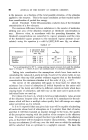
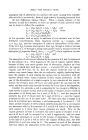
JOURNAL OF THE SOCIETY OF COSMETIC CHEMISTS kept in constant motion towards the nasopharynx by the plentiful supply of cilia in the respiratory membrane and is replaced by a fresh layer of liquid about once in ten minutes. This mechanism has several functions' it warms and humidifies incoming air, regulates the air currents in the nasal cavity, acts as a filter and, as a result of the action of the enzymes it contains, keeps the olfactory area sterile. The olfactory portion, which in man is about 5 sq. cm., lines nearly all of the superior turbinate, a little of the middle turbinate and the top third of the nasal septum. It has neither cilia nor a distinct membrane, is yellowish brown in colour and has three principal kinds of cells, our interest being in the olfactory ones, which comprise some 70 per cent of the total. An olfactory cell tapers in one direction to a non-medulated nerve fibre attached to a glomeruli which also receives the fibres from several hundred other olfactory cells in the other direction it tapers to a short nerve fibre, ending in a small enlargement or bulge called the olfactory "vesicle." The olfactory vesicle has many short hairs which project into the mucous covering of the nasal cavity ß they are about 1-2/x long and 0' 1 t• in diameter. Hainer et al.• and Mozell and Pfaffman 6 both summarise findings of Allison and Warwick 7 for the nerve system of the olfactory area of the rabbit. In each nostril there are about 50,000,000 olfactory receptors, connected between them to 1,900 glomeruli. Each glomerulus communicates with about 24 mitral cells and 68 tufted cells, the latter being interconnected with the glomeruli of similar cells of the opposite nostril. The mitral cells are con- nected to the olfactory area o! the brain. In the rabbit, each vesicle has an average of ten hairs attached to it, but in man the average is 5-6 (Warwick and Le Gros ClarkS Allison and Warwick7). There are between 10 and 100 x 106 nerve fibres serving the olfactory nerve ß this compares with 1 x 10⁶ for the human eye and 0'08 x 106 for the ear. There is thus the message system available in the nose for a very great variety of simultaneous messages. (e) The Properties of Gases. In order for a substance to be smelled, as was shown by J. Aitken • to be true for musk, molecules of it must be present in the air passing the olfactory area, and in order that this shall occur the substance must be vaporisable. It is frequently a liquid, although not necessarily so, for vapour can be formed directly from the solid state of many substances ' examples are ice, musk ambrette, coumarin, camphor, vanillin. A liquid consists of molecules constantly moving with varying velocities greater or smaller than an average velocity which depends on the temperature of the liquid. In order to have enough kinetic energy to leave the liquid a molecule must have a velocity greater than the average' e.g., in water at 0 ø C. a molecule needs a velocity of around 1'45 x 10 • cm. per second in order to leave the liquid, whereas the average molecular velocity in the liquid will be about 6 x 104 cm. per second. The rate of escape of molecules depends

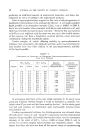
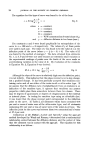
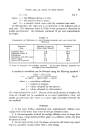
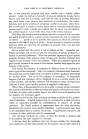
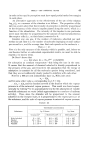
SMELL--THE PHYSICAL SENSE on the shape of the surface of the liquid ß thus con vex surfaces lose molecules at a greater rate than flat, which in turn lose them faster than concave surfaces ß in effect, the vapour pressure near a liquid depends on the shape of its surface. The liquid surface is a diffuse demarcation, a few molecules thick, between liquid and vapour. Molecules are continually leaving the surface and returning to it from both directions, remaining on the surface for very short periods. The surface molecules of some liquids, such as water and ethyl alcohol, are orientated on the average, and generally the concentration of solutes on the surface is not the same as that in the bulk in some cases it is in excess, in some in a deficiency. According to the kinetic theory of gases, in a vapour the molecules are moving in short straight paths of high velocity until they collide with other molecules, when both colliding particles move away in altered directions and at altered speeds. The mean path length of a particle depends on the tem- perature of the gas the mean velocity on the temperature and molecular weight of the gas, and the mean number of particles hitting a surface on its temperature, molecular weight and pressure. The mean length of free path of the molecules is given approximately by the equation L -- (2'78 , 10-5)T/273p, where L is in c•n., T is the absolute temperature, p is in millimetres of mercury. The kinetic theory leads to the equation -- U-= •/(8Rr)/•/(rrM) cm./sec. -- 145'55/T/•/M metres/sec. -- for the speed of any molecular species, where U is the mean velocity, M the molecular weight, R the gas constant, ,r is 3'141•. Assuming that the gases passing over the olfactory area have a tempera- ture of 32 ø C., we find the values of mean velocity of the molecules of the gases of some typical perfumery chemicals shown in Table I. TABLE I Substance Mean velocity, metres/second. Ethyl alcohol Pyridine .. Ethyl acetate Phenol .. Coumarin Cinnamic alc•)•ol Methyl anthranilate Vanillin •e-decyl alcol•( 1 Eugenol .. Ethyl cinnamate Isobutyl benzoate Benzyl benzoate 374 285 269 262 210 208 207 207 202 199 191 191 175
Purchased for the exclusive use of nofirst nolast (unknown)
From: SCC Media Library & Resource Center (library.scconline.org)