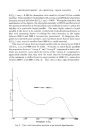
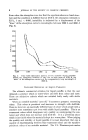
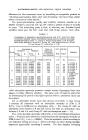
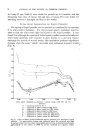
70 JOURNAL OF THE SOCIETY OF COSMETIC CHEMISTS evaporating substance nor the quantity of substance--within a factor of two--whose evaporation time was measured, nor determine the end of the evaporation except by the substance becoming below the threshold con- centration in an unknown amount of air, nor take any steps to determine the purity of the substances used. There is obviously positive regression between these two incompletely founded sets of results. However, it is unlikely to be a simple relation, as can be seen from the following considerations. The saturated vapour pressure at absolute temperature T of a liquid is related to its latent heat of evaporation by log,p s = I3 -- Q/RT, where Q is the latent heat of evaporation and B a constant. This enables Ps to be calculated from the latent heat of evaporation. It can also be calculated from the number of molecules hitting the surface in unit time, as has been done earlier in the article, n = N•,,/V'(2rtMRT ). These calculations assume that the continuous evaporation and condensation process, whereby mole- cules are continually leaving the surface whilst others are condensing in it, goes unhindered by reflection of the condensing molecules at the surface. If a fraction • is reflected, then only n (1 -• •) will condense and equilibrium exists when the rate of evaporation is n (1 -- •): the maximum rate of evaporation is now no longer represented by the equation for n. The effect of reflection can be very considerable, as is shown by determina- tions of the rate of evaporation of polar molecules such as water at known values of p, when as much as 9•3 per cent of the particles of gas striking the surface are reflected, reducing the rate of evaporation to 4 per cent of its maximum calculated rate. • In a perfume, which is a solution of several substances, such a reflection effect will result in a considerable degree of fixa- tion of the more volatile constituents of a perfume. Sharing the available surface of the liquid with another molecular species will also reduce the rate of evaporation, as will orientation of the surface molecules. Fixation is thus a matter of reduction of the surface available to the more volatile molecules and/or a change in nature of the surface so as to increase the reflection of molecules striking it, and, being a surface phenomenon, small amounts of foreign substances can have large effects. J. Pickthall -ø• discusses fixation on the basis of deviations from Raoult's law, suggesting that dipole association and/or hydrogen bonding have sub- stantial influence. P&R• I¾ FUTURE WORK The greatest gaps in our knowledge of olfaction are those concerned with the identify of the odours which cause maximum response from particular receptor$, and with the adsorption of the tnolecules on the receptors.

SMELL--THE PHYSICAL SENSE 71 The types of receptors can be identified from the study of their physio- logy. This is being attempted by Lord Adrian '•a, and here the work of Derbier -ø" ,•nd others on the physiology of the receptors of insects will be helpful. An adaptation of the "flicker technique" should also be useful, for if odours at concentrations near to their thresholds could be presented in pairs to the receptors in alternating impulses, those which stimulated different types of receptor would be perceived as separate odours at higher frequencies of presentation than odours which overlapped several types of receptor. This can be done by using "Maxwell's colour mixing device", by painting solutions of odorants on to a disc whose speed of rotation can be varied in a known manner the disc can be made of wire mesh and a low pressure jet of air can be smelled after passing through the disc. Such an apparatus lends itself to the very necessary simple and rapid alternating change of odour. Work needs to be done on the evaluation of threshold concentrations in terms of threshold vapour pressure as a fraction of saturated vapour pressure. This involves the measurement at 30-:38 ø C. of the saturated vapour pressures of a wide range of substances whose vapour pressures are very small. Once the threshold is known, the relation between the intensity of perception and the activity of the stimulus should be investigated. It will be interesting to discover the minimum number of quanta needed to perceive a smell. It is striking that nearly everyone who investigates olfaction omits to give details of the purity of the chemicals which they have used as odorants mostly they seem to take no steps whatever to make sure that they are dealing with a single substance. Until steps are taken by workers to determine the purity of their materials, it cannot be expected that a great deal of progress will be made, since synthetics sometimes owe their characteristic odour to impurities present in small quantity--e.g., see Krajkeman •. To know the threshold of an impure chemical is useless if the impurity is an odoriferous body. Detection of impurities is not difficult with the modern methods of infra-red spectra analysis, and the even newer--and possibly more useful--gas chromatograms. When it is recalled that individuals vary in their perception of odour and that therefore the effect of each odorant will have to be determined on a large number of them, it is seen that there is an enormous amount of work to be done. The author suggests that all workers in this field should set up a co-ordinating body to ensure that their efforts do not overlap and to advise those wishing to commence work on oilaction of the areas of research which most need attention and of the most successful methods of investigation. In this way the various research projects could be kept in balance and arranged to complement each other. One very important function of such a central body could be that of issuing samples of odorants of known purity.
Purchased for the exclusive use of nofirst nolast (unknown)
From: SCC Media Library & Resource Center (library.scconline.org)