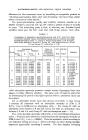
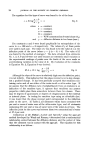
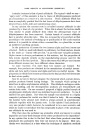
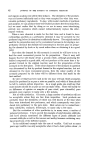
68 JOURNAL OF THE SOCIETY OF COSMETIC CHEMISTS and be itself adsorbed in its place: thus b will give a certain amount of perception of the quality A, and a of B: in this way it will be less easy to differentiate between the odours as the total vapour pressure rises, as the charactm, of their individual perceptors will be less sharply defined. (h) (iv) Change of Quality. The change in quality of an odorant as its concentration alters has a similar basis. Close to their threshold vapour pressure the first molecules to be adsorbed on the hairs of a certain receptor cell type for which they have maximum adsorption will give rise to a specific perception of quality characteristic of the receptor, but as the vapour pres- sure rises, more and more of the other receptors will be stimulated and the total perception must be modified in character. Substances which have a masking effect will also change in quality of perception as their vapour pressure increases. The converse is not true, for a natural product, which is a mixture of substances, would also be expected to change in quality with dilution, because as its total vapour pressure rises, since the threshold vapour pressures of its components will be reached in succession it will stimulate a wider range of receptors at. their specifically active spots. (A masking agent might have no selective adsorption on the "active spots" if it did not happen to contain the general molecular shape and structure necessary to respond to the specific attraction of the spot.) Such a natural product would not be a masking agent unless some of its ingredients also had high general levels of heat of adsorption. (h) (v) Effect of Velocity of Air Stream. The olfactory threshold is the concentration of gas which gives a sufficient number of adsorbed molecules to stimulate the olfactory receptor. It takes time for the adsorbed layer to reach this level, for as odorant molecules are taken away from the gas the vapour pressure of the odorant in the neighbourhood of the adsorbing layer is lowered and recovers to the general concentration only after diffusion has taken place. An air blast might be thought to increase th• speed of diffusion and reduce the time taken for the adsorbed layer to reach the threshold concentration by a detectable amount, but this will not alter its concentra- tion. However, it is possible that when an odorant is smelled in an air blast, as a result of the raised rate of evaporation of liquid water, the water vapour pressure is reduced below that of its saturated value, and this accounts for the apparently lowered threshold value obtained by air blast methods. In its simplest, the effect of water vapour is a case of the adsorption of two gases, one in much greater amount than the other--so much greater that generally bwp w will be in large excess of b•p a. An example will make this clear: Pv•iz•i• at threshold is about 5 x 10-•*, whilst p• for water is about 35.6, and by is unlikely to be more than 10 • times bw: therefore b•p• is about 10 • times b•p• and the adsorption of vanillin will be affected by the vapour pressure of the water (% -- (%)• b•pv/(1 +

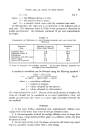
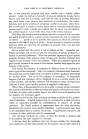
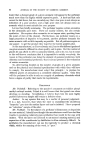
SMELL----THE PHYSICAL SENSE 69 bwpw) ). If the blast gases reduce the vapour pressure of water, b•,p• will be correspondingly decreased and the threshold vapour pressure of vanillin will be reduced. (i) Masking. Masking by powerful odorants, such as methyl ionones, which can mask other odorants when in high concentration, no doubt arises through their having a moderately high heat of adsorption for the hairs of many types of receptors. As a result of this they reduce the overall amount of the other odorants adsorbed, to which the receptors might individually have higher heats of adsorption at their specifically active spots, and conse- quently depress their specific odour quality, impressing on the whole their more general odour. (j) Fixation. Fixation is a retardation of the expected rate of evapora- tion of the more volatile constituents from a solution of substances. The rate of evaporation of molecules from the liquid surface of a solution depends on the average fraction of the surface occupied by its species, on the reflection of its gas molecules from its surface, on the temperatures of the liquid and the gas, and on the rate of diffusion to the surface from the bulk of the liquid. In the case of a liquid in equilibrium with its own vapour, when a vapour molecule hits the liquid we can consider that it is completely adsorbed and stays in the liquid. Since the liquid is in equilibrium with its vapour, the number of molecules condensing is equal to the number evaporat- ing, vhich is our number Jr. We can use this to obtain some information about the process of fixation. The maximum rate of evaporation can be calculated from the equation for n given on page 56. W. A. Poucher a0 has determined relative rates of evaporation (disappearance) of the same substances by a rule of thumb method, and some of his rates of disappearance are compared with the calculated maxima in Table V. He did not control the vapour pressure of the TABLE V Rate of disappearance according to Poucher. Top notes: Ethyl alcohol Methyl butyrate Amyl proprionate Isobutyl benzoate Decyl alcohol Middle Notes: Eugenol Methyl anthranilate Ethyl cinnamate Bases: Cinnamic alcohol Coumarin Vanillin Calculated max. rate oi evap. gram/cm.a/sec. 1 4 4 8 11 16 21 24 lOO lOO lOO 4-2 1.6 0.12 0,0053 0.0051 0 0018 0.0018 0,0015 0 0008 0.0007 0 00008
Purchased for the exclusive use of nofirst nolast (unknown)
From: SCC Media Library & Resource Center (library.scconline.org)