PENETRATION OF SKIN--DEAD AND ALIVE 229 PENETRATION OF SKIN--DEAD AND ALIVE R. H. MARRIOTT, D.Sc., F.R.I.C.* A lecture delivered before the Society o• 18th December 1957. The l•enetration of skin by oily materials dellends on the sl•reading of the oil on free water surfaces, bo• with dead skin (tanned) and •he living skin. Examl•les are given of •he effect of various forms of emulsion on the ability of the tol•ically al•lflied material to l•ene•ate into the el•idermis, and also through •he el•idermis into •he blood stream. In the case of water- soluble substances, the ionisa•ion factor has to be considered in resl•ect of mobility of •he ions. In the case of weak acids or bases, the l•ermeability can occur insomuch as un-ionised molecules are free to diffuse through the electro- static barrier of the el•idermis. Various forms of emulsifying agents are also dealt with, including the ionic, non-ionic and aml•holytic surface-active agents and the suitability of the many varieties of emulsions as bases for the inunc•ion of the intact skin. THE PROBLEM or, perhaps better, problems of the permeability of skin are intrinsically bound up in the science of cosmetology since our industry is based on topical application. Often, of course, it is not desirable for penetra- tion to occur, but, in general, some is desirable. A superficial glance through the literature indicates that the subject has attracted a large number of workers, but often their findings appear to be at variance and the enunciation of principles governing the penetration of substances into the skin has been difficult. It is the purpose of this lecture to try to sift out some of the factors which play their part, how they do so, and what use can be made of them. During the preparation of this lecture an outstanding treatise on the science and technology of cosmetics • became available in this country. This tome, which was edited by our esteemed American colleague, Sagarin, with the help of an editorial board of four eminent American cosmetic chemists, covers practically the whole field of our industry--and in no mean fashion. It contains a chapter written by Peck and Michelfelder on the physiology of the skin, and it is easy to understand that this lecture must inevitably impinge on their story. Although all of you are well acquainted with the purpose and structure of skin, it is somewhat necessary to deal with this in a form which will facilitate the story and the method with which the subject will be treated. * County Laboratories Ltd., Stanmore, Middlesex.

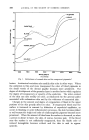
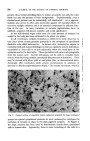
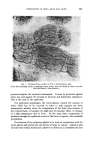
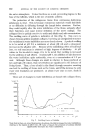
230 JOURNAL OF THE SOCIETY OF COSMETIC CHEMISTS Perhaps one may quote Macaulay's well-known phrase to start with, and having said "As every schoolboy knows," accept this as governing all the statements which are "old news." The fertilised ovum consists of three layers, the thin outer one or cuticle being the embryonic epidermis. As it grows it develops into the complexly structured epi. dermis, which includes the hair, nails, and the glands which secrete sweat and fats. In addition, the cells differentiate themselves into those which cover the lips, the eyes, and the surfaces of the mouth, and other portions of the oral and nasal passages. The second layer of the ovum builds up into the cutis vera or corium, which is mainly collagenous. This portion is the major constituent of the whole skin and acts as the integument enclosing the whole •)f the living body, with its multiplicity of organs and bones, etc. The thickness of this layer, as with the epidermis, varies according to its particular site on the body. The skeletal structure, the flesh, muscles and organs are derived from the inner portion of the ovum. From these the arteries, capillaries, blood vessels and nerves extend into the corium, maintaining the true skin as a living entity. The purpose of the skin is to enclose the living body, holding it together and at the same time protecting it from physical force--a sort of cushion. The corium is mainly composed of collagen fibres that appear to be funda- mentally fibrils which are gathered together into fibres and are held together as small bundles of varying thickness. The fibres are further held together in more or less parallel groupings into larger fibres or fibre-bundles. In general, the fibre-bundles constitute the corium below the level of the hair roots, merging off into fibres of less massive character towards the epidermal layer. The fibres appear to be held together by reticular tissue 2 (Fig. 1). In the young animal the reticular tissue is almost complete, but decreases in strength with age. The fibres and bundles of the corium interweave in all directions, but the angle, notably in a direction vertical to the surface, becomes less in those parts where flexibility is required. Running through the interweaving fibre structure are the elastin fibres which give added strength to the structure, notably round the arteries and the hair follicles. All this structural detail ensures the perfect flexibility that is necessary to permit movement of the body--an elasticity adequately tempered by plasticity. The three-dimensional structure is unique in character and properties. No man-made substitute has yet, if ever, simulated all its virtues, and it is easy to understand why, when it has been made imputrescible by the tanner, the product, leather, is supreme. It is one of nature's master- pieces in design to fit the job. In the living animal this functional, highly hydrated structure has to be
Purchased for the exclusive use of nofirst nolast (unknown)
From: SCC Media Library & Resource Center (library.scconline.org)