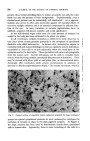
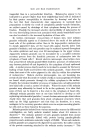
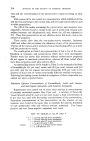
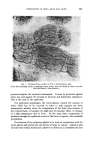
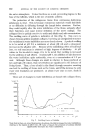
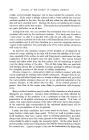
ß PENETRATION OF SKIN--DEAD AND ALIVE 231 i". "-•' &' :--'•: '-•',.-•½' ..r -', ,. -..•.• ..... . .•..,,, "'.2 ,•:•- •.'4½.½*',,. •' '• ,•: •--:' •.'• . .•. Fig. 1. Collagen Fibres swollen in 0-01 N Hydrochloric Acid. (Note the encircling bands of reticular tissue which hold the fibrils in fibres and also . hold the fibres in fibre-bundles.) protected against the external environment. It must be protected against water loss and against the inroads of bacteria and deleterious substances. This is the task of the epidermis. The epidermal appendages, the sweat glands, control the amount of water which has to be excreted in order to help regulate the body temperature, notably when the temperature of the body rises because of the external heat, or because of a high rate of muscular effort, or because of a high temperature due to fever. At the same time, evaporation of moisture through the epidermis occurs in the form of vapour--the insensible perspiration. The function of the sebaceous glands is to work in conjunction with the sweat glands and control the rate of loss of water as vapour. Sebum is able to hold water within itself and to allow it to diffuse at a controlled rate into

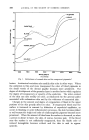
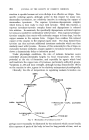
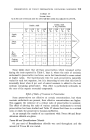
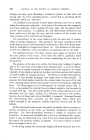
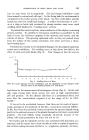
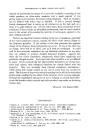
232 JOURNAL OF THE SOCIETY OF COSMETIC CHEMISTS the outer atmosphere. It also functions as a seal, preventing ingress to the base of the follicles, which is the site of mitotic activity. The protection of the collagenous tissue from extraneous deleterious substances is vital. This is because extraneous materials would find little or no difficulty in diffusing through the lymph-laden structure. Further, they could rapidly alter the water imbibition of the fibres, seriously affect their functions, and cause intense irritation of the nerve endings. The collagen fibre is quickly reactive to acids and alkalis and salt concentration. The swelling curve of gelatin is indicative of this (Fig. 2). This curve is chosen because gelatin simulates collagen, but being an unorganised structure the variations in water imbibition are more clearly shown. A peak of swelling is to be noted at pH 2-3, a minimum at about pH 4-8 and a subsequent increase on the alkaline side. Because of the solubilising effect of hydroxyl ions, no real maximum is attained at high degrees of alkalinity. At pH values in the iso-electric range, it is to be noted that swelling is increased by the addition of salt (NaC1). At about pH 7, the addition of salt decreases the water imbibition quite noticeably, even at a concentration of 1.2 per cent. Although these changes are small in relation to those produced at low and high pH values, they nevertheless are significant in the instance of living tissue. Thus, a loss of salt in the blood through excessive sweating can lead to swelling of tissue such as the brain, and if the increase be only 2 per cent headaches are produced at about 3 per cent or more, death is certain. These sort of changes in water imbibition are found with collagen fibres, •'J• ItaH T 7000 L 00o 5000 $00o •ooo IOOO I I I [ I I I I I I I I o • • 3 • 5 g 7 • q •o •l I• •H Fig 2. Swelling Curve of Gelatin. Note that in the i.e.p. area the presence of sodium chloride increases the water imbibition, whereas in the region of pH 7 (the pH value of blood) the presence of sodium chloride significantly decreases the water imbibition.
Purchased for the exclusive use of nofirst nolast (unknown)
From: SCC Media Library & Resource Center (library.scconline.org)