136 JOURNAL OF THE SOCIETY OF COSMETIC CHEMISTS this fact is one which appears to be relatively immutable. Possibly this Ionian Greek philosopher was stimulated to make this observation be- cause he was living in a time in which fire was thought to be one of the (if not the) primordial substances we too have, of course, observed that a flame, being such a changeable thing, may well be a symbol (possibly a clue?) that all things are subject to a general and ceaseless process of alteration. Regardless, Heraclitus stressed the constancy of change, and here we wish to discuss change as it affects the products we create. PROGNOSTICATION The purpose of this section will be to review basic, classical chemical kinetics, to indicate the rationale behind choosing certain of the pertinent principles from this segment of physical chemistry, and to demonstrate how these new tools may be used. For our purposes, the basic aim is to learn how to follow reaction rates in an efficient and orderly manner, i.e., in a way that makes pos- sible prediction of the future behavior of the system being observed. By reaction rate we mean the rate of degradation of a material. We will equate the degradation of a material to the disappearance or lowering with time of the concentration of a component of the formulation under observation. Basically, we can review the possible happenings by con- sidering two concepts: molecularity and order. Consider first the molecularity of reactions. A unimolecular reaction is one in which only one molecule takes part, as in, e.g., a dissociation or rearrangement. In a bimolecular reaction two molecules are involved, and collision of the two is needed. Most of the familiar reactions of formation would fall into this class. A termolecular interaction in which three molecules are involved in simultaneous collision is rare and is not unlike the problems acknowledged by the familiar "three is a crowd" adage. For practical purposes, molecularity is most easily interpre- table, i.e., east into useful form, by observing experimentally how a rate of reaction or degradation is influenced by the concentrations of the react- ing or degrading materials, regardless of how the actual happenings are taking place on a molecular scale. The next concept needed then is that of reaction order definitions follow: First Order. The rate is directly proportional to the concentration of the material reacting. Mathematical treatment yields an equation describing this situation:

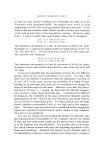
PRODUCT STABILITY--PART I 137 k = (2.303/0 log (Co/C) = (2.303/t) log (a/a - x) where: t = time co = cart = 0, c = cart = t, k = specific reaction rate constant units = time -1, a = original amount, x = amount reacting in time t. By substituting Co = 100 and c = 50 the familiar half-life equation and concept is developed: tl/2 = 0.693/k Obviously, one can use these equations after enough data are available to evaluate the specific reaction rate constant after this either other times or other concentrations can be substituted into the equations to determine unknowns. Graphically, the most useful method involves a plot of log c rs. time k then equals (-2.303) times the slope, which is negative. Second Order. The rate is proportional to the concentrations of two materials or ingredients, e.g., A and B. Mathematically, two results are possible. Lower case "a" and "b" represent corresponding concen- trations of A and B. When a = b: k = (l/t) x/a(a-x) When a•-b: k = [2.303It(a-b)] log[b(a-x)/a(b-x) ] Units of k = volume amount -1 time-L Graphically, log [b(a-x)/a(b--x)] is plotted rs. time k then equals (2.303/a--b) times the slope, which is positive. Pseudo First Order. If one reactant is in great excess in a second or- der reaction, the reaction may be bimolecular, but it will appear to be first order in fact, it will actually be first order by definition. Order is an experimentally made observation which is not necessarily connected to the reality of any particular molecularity. Two more orders are worthy of mention, even though they may not be applicable to the techniques which may ultimately be required. Zero Order. The rate is not affected by concentration, but rather it is set by some cutside limiting factor such as the absorption of light, the rate of diffusion in a surface reaction, or somewhat similarly, the maintenance of a constant concentration due to the involvement of a saturated solution.
Purchased for the exclusive use of nofirst nolast (unknown)
From: SCC Media Library & Resource Center (library.scconline.org)