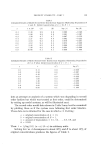
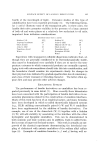
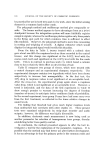
PRODUCT STABILITY--PART I 137 k = (2.303/0 log (Co/C) = (2.303/t) log (a/a - x) where: t = time co = cart = 0, c = cart = t, k = specific reaction rate constant units = time -1, a = original amount, x = amount reacting in time t. By substituting Co = 100 and c = 50 the familiar half-life equation and concept is developed: tl/2 = 0.693/k Obviously, one can use these equations after enough data are available to evaluate the specific reaction rate constant after this either other times or other concentrations can be substituted into the equations to determine unknowns. Graphically, the most useful method involves a plot of log c rs. time k then equals (-2.303) times the slope, which is negative. Second Order. The rate is proportional to the concentrations of two materials or ingredients, e.g., A and B. Mathematically, two results are possible. Lower case "a" and "b" represent corresponding concen- trations of A and B. When a = b: k = (l/t) x/a(a-x) When a•-b: k = [2.303It(a-b)] log[b(a-x)/a(b-x) ] Units of k = volume amount -1 time-L Graphically, log [b(a-x)/a(b--x)] is plotted rs. time k then equals (2.303/a--b) times the slope, which is positive. Pseudo First Order. If one reactant is in great excess in a second or- der reaction, the reaction may be bimolecular, but it will appear to be first order in fact, it will actually be first order by definition. Order is an experimentally made observation which is not necessarily connected to the reality of any particular molecularity. Two more orders are worthy of mention, even though they may not be applicable to the techniques which may ultimately be required. Zero Order. The rate is not affected by concentration, but rather it is set by some cutside limiting factor such as the absorption of light, the rate of diffusion in a surface reaction, or somewhat similarly, the maintenance of a constant concentration due to the involvement of a saturated solution.

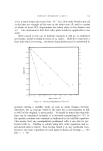
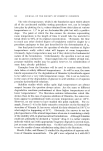
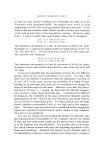
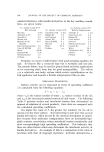
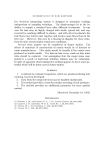
138 JOURNAL OF THE SOCIETY OF COSMETIC CHEMISTS Third Order. The rate is proportional to the concentration of three reacting substances. For these purposes, third order reactions are considered to be too rare and will not have to be considered. Other complex reactions are noteworthy, but similarly, they will not affect our use of chemical kinetics. By complex reactions are meant consecutive reactions, competing reactions, and reverse reactions in which equilibria are set up which mass-wise are neither near to the be- ginning nor near to the point of completion. The reason confusion does not run rampant, considering the many realistic possibilities, is that, in general, some limiting step predominates such that experimentally we are able to observe the behavior of some single entity or parameter. Before we try to organize and use the just-discussed physical-chemical information, one more concept, the role of temperature, should be noted. That reaction rates increase with temperature is a well-known observa- tion amply illustrated by every-day experience. This fact has been quantitated and incorporated in the scheme of chemical kinetics by the well-known Arrhenius equation: log (k2/kl)= (AHa/2.303I•)Cl•- ]•l/T2T•) where: /XHa = heat of activation R = gas constant T = absolute temperature ( øC 4- 273 ø) Graphically, a straight line of negative slope results when log k is plotted rs. I/T the slope = (--Atta/2.303R). Now that the foundation has been laid, we must choose which type of edifice to build and then justify the nature of the architecture. First, it is obvious that the role of temperature can be incorporated into the scheme of things by employing the well-known "accelerated studies" in which formulations are stressed by storage at various elevated temperatures. Secondly, a variation of the half-life concept will be used in which a too is employed, i.e., the time it takes for 10% degrada- tion or for a drop to 90% of the original concentration of a material. This will be illustrated later. Thirdly, first order kinetics will be utilized because of the ease of application. Amplification of these points will be effected in reverse order. First, the validity of using first order kinetics should be verified. One should be sure that use of this order will not be misleading if the sys- tem under observation is, in fact, degrading according to second order kinetics. The existence of confusion or the lack of it, which would enter
Purchased for the exclusive use of nofirst nolast (unknown)
From: SCC Media Library & Resource Center (library.scconline.org)