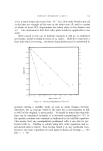
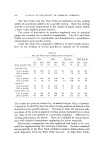
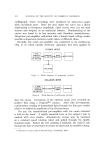
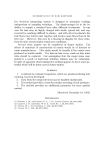
PRODUCT STABILITY--PART I 141 or by a much larger adversary (line "B," 10x), first order kinetics prevail as the lines are straight all the way in the latter case (B) and to a point at which at least 50% degradation has taken place in the former case (C). Our conclusion is that first order plots should be applicable to our work. With regard to the use of half-life concepts it will be, as indicated previously, useful to think in terms of too values. Half-lives represent a time unit which is too long obviously degradation must be monitored in -0.1 -0.2 -0.3 -0.6 -0.7 -0.8 -0.9 • 5 7 Time or Time x 102 Figure 2. Percent Degradation of B or C c 1c 20 30 •$o 5o 7o 8o ! 9 products during a stability study as soon as small changes develop. Therefore, the t90 concept, which is the time for a concentration to fall to 90% of the original, is most useful. It should be noted also that this time can be correlated (actually, it is inversely proportional to "k") to the specific reaction rate constant as indicated in the half-life equation. This means that any manipulation performed with k can also be per- formed with too. Finding too entails using first order equations and ex- perimental data to find k then having found k at any particular tem- perature, the same equations are used again to find too by setting co = 100 and c = 90.

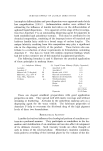
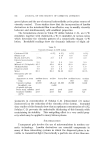
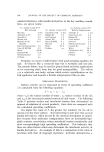
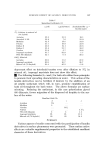
142 JOURNAL OF THE SOCIETY OF COSMETIC CHEMISTS The role of temperature, which is the foundation upon which almost all of the accelerated stability testing procedures rest, can be brought into play by plotting the too values obtained from data taken at various temperatures vs. 1/T to get an Arrhenius-like plot but with a positive slope. The point at which the line crosses the abscissa representing room temperature is the length of time it would take the material to break down to 90% of its original concentration. Obviously, the time to reach any other desired degree of breakdown could be sought by a procedure analogous to that just described for the determination of too. One final point involves the question of whether reactions at higher temperatures really reflect what will happen at room temperature. Obviously, higher temperatures may not if they destroy the fundamental nature of the formulation. Unfortunately, the question is not an easy one to answer conclusively. Some insight into the validity of high tem- perature stability studies may be gained, however, by consideration of some data already published. Examples from the literature will be used to examine some kinetic data taken at widely different temperatures. As will be seen, the same kinetic expressions for the degradation of thiamine hydrochloride appear to be valid over a very wide temperature range this is not so, however, in the cases of the degradation of glucose in acid solution or of aqueous procaine hydrochloride solutions. Stability studies which utilize quite high temperatures are always suspect because the question always arises: Are the same or different degradative reactions predominant at these higher temperatures as at lower temperatures? The literature contains information which illu- strates that, in the case of aqueous solutions of thiamine, the same reac- tions appear to predominate both at room temperature and at 140øC. However, no one seems to have studied this point explidtly. For ex- ample, Farrer (1-4) in his fairly extensive researches on the thermal de- struction of Vitamin B• has never related his data obtained at 100 øC to what might be happening at 25øC. Obviously, the answer to our im- plied question is of the utmost importance when one is considering a study of the stability of B• in pharmaceutical formulations. Although thiamine could not arbitrarily be declared a "typical" drug, it is a rather complex molecule which can (with appropriate reagents) degrade in several ways, just as many other compounds may. On this basis then, it is interesting to see the results of some calculations using data in the literature. Macek, Feller, and Hanus ($) studied the degradation of aqueous solu- tions of thiamine mononitrate. The pH's were adjusted to 4 with HC1
Purchased for the exclusive use of nofirst nolast (unknown)
From: SCC Media Library & Resource Center (library.scconline.org)