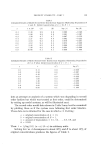
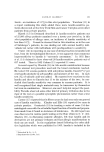
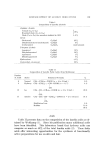
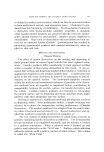
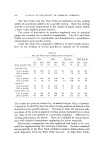
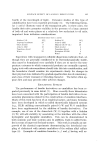
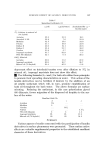
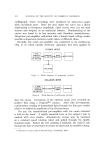
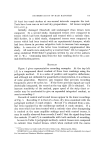
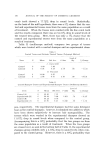
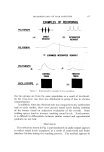
SURFACE EFFECT OF LANOLIN DERIVATIVES Table I Composition of Lanolin Alcohols 159 A liphatic AIcohols Normal (C•s to C.,•) Branched chain (C17 to C.,•) Diols (C1• to C.,4) five members isolated in 1951 Sterols Cholesterol C.,7H460 Dihydrocholesterol (cholestanol) C.,,H4sO Cerebrosterol C27H4702 Triterpene Alcohols Lanosterol C.•0H500 Dihydrolanosterol Ca0H520 Agnosterol C30H4sO Dihydroagnosterol Ca0H•00 Hydrocarbons -Unclassified--at present 18% 4-5% 25% 5% s•nall amount •o% lo% 1% 4% •% 20% Table II Composition of Lanolin Fatty Acids (from Weitkamp) Number of Acids Series Structural Formula 9 Normal 2 Hydroxy 10 Iso 11 Anteiso CH•--(CH,,),•n--COOH (n -- 4 to 12 incl.) 9.5 CH•--(CH2)•n-•--CH--COOH (n = 6, 7) 4.2 OH CH•--CH--(CH,•),•,•COOH (n = 3 to 11 incl.) 29.3 I CH3 CHa--CH2--CH--(CH,,)2n--COOH (n = 2 to 13 incl.) 37.3 I CH3 Distillation Loss 6.0 Residue 13.0 99.3 Acids Table II presents data on the composition of the lanolin acids as ob- tained by Weitkamp (1). Since his publication many additional acids have been identified. This laboratory found that hydroxy acids can comprise as much as 40% of the total lanolin acids (2). These fatty acids offer interesting opportunities for the synthesis of functionally active preparations for use on skin and hair.

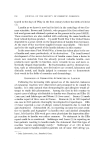
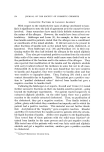
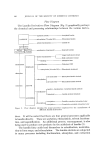
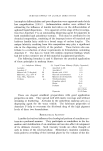
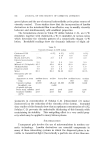
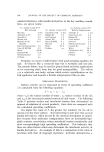
160 JOURNAL OF THE SOCIETY OF COSMETIC CHEMISTS Flow Diagram The Lanolin Derivatives Flow Diagram (Fig. 2) graphically portrays the chemical and processing relationships between the various deriva- LANOLIN I saponilfication I TOAL I IFA}T¾ ALCOHO•Sl I ACIDS fraetionation adsorption extraction SURFACE ACTIVE ALCOHOL• acylation (acetic) ethoxylation (75 moles EO) solvent fractionation Acetylated fanolin Ethoxylated lanolin Lanolin oil esterification (isopropanol) Isopropyl lanolate --further fractionation - L blending •Liquid multi-sterol extract Solid multi-sterol extract Absorption base --crystallization Cholesterol USP ethoxylation (24 moles EO)•Ethoxylated cholesterol (16 moles EO) -- ethoxylation 1 I-(25 moles EO)-- -- Ethoxylated lanolin alcohols Ethoxylated lanolin alcohols (acetie)--fractionation--Aeetylated lanolin alcohols --esterification• I-(ricinoleic) Lanolin alcohols ricinoleate r- acetylation thoxylation-] I_ acetylation Partially acetylated ethoxylated ester Completely aeetylated ethoxylated ester Figure 2. Flow diagram showing the usual processes employed for the manufacture of different lanolin derivatives tives. It will be noted that there are four general processes applicable to lanolin directly. These are acylation, ethoxylation, solvent fractiona- tion, and saponification. An additional process, rearrangement, is also being used to produce new products by the acidolysis of lanolin (3). The lanolin fatty acids lend themselves to esterification, neutraliza- tion to form soaps, and ethoxylation. The lanolin alcohols are subjected to many processes including fractionation, adsorption, and extraction
Purchased for the exclusive use of nofirst nolast (unknown)
From: SCC Media Library & Resource Center (library.scconline.org)