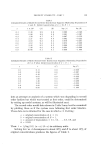
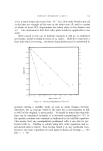
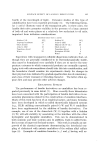
PRODUCT STABILITY--PART I 143 so that the ionic species resulting were essentially the same as in the Watanabe study mentioned below the samples were stored at room temperature and 40 øC for varying periods of time up to one year. These workers did not calculate either kinetic specific reaction rate constants or the heat of activation of the degradative reaction. However, using their 1, 6, and 12 month data, approximate values can be calculated: 25øC: k = 4.80 X 10 -a mo. -1 4()øC: k = 4.05 X 10 -2 mo. -• This situation corresponds to a heat of activation of 29,000 cal./mole. Watanabe (6, 7) carried out similar studies at temperatures of 100, 110, 120, 130, and 140øC. For his study done at pH 4.2 he lists these spe- cific reaction rate constants: 100øC: k = 2.7 X 10 -2 hr. -• 110øC: k -- 6.9 X 10 -2 hr. -• This situation corresponds to a heat of activation of 26,100 cal./mole Watanabe, on the basis of all his data, lists the value of the Alia as 31,000 cal./mole. It may be concluded that the agreement between the two different groups' value for the heat of activation is very good. Of course, this alone does not indicate conclusively that the degradative reaction at 25 and 110øC is the same, because the possibility of a family of lines existing on an Arrhenius plot must not be overlooked even though the slopes of the lines might be the same. However, even with the conver- sion factor 720 hours = 1 month, the data from the different tempera- tures do form a single linear Arrhenius plot. Considering the different investigators, the variability of the assay method for thiamine, and the approximation of time values in the year-long study, agreement between the two studies is surprisingly good. The data indicate that the same kinetic situation predominates both at very high and at low tempera- tures. This then is one case which can be considered neither completely typical nor completely atypical but in which studies at high tempera- tures prove to be significant. It is easy for anyone who has studied the kinetics of relatively com- plex pharmaceutical formulations to cite examples wherein the results of high and low temperature studies do not present such a tidy picture as in the thiamine case just discussed. It is possible also to cite exam- ples which concern systems with only one degrading ingredient to illu- strate such situations. Heimlich and Martin (8) in a detailed study of the degradation of glucose in acid solution have shown that a change in

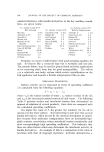
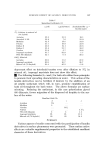
] 44 JOURNAL OF THE SOCIETY OF COSMETIC CHEMISTS mechanism appears to take place at temperatures at and below 100øC as compared to studies done between 100 and 150 øC. Similarly, Oote- ghem and Steiger (9) showed that the hydrolyric process in degrading aqueous procaine hydrochloride solutions is not the same at 20øC and above 80 øC, so that, e.g., a study done at 100 øC will not permit calcula- tion of the degradation rate at 20 øC. Finally, although the kinetic basis upon which stability studies rest is not absolutely unequivocal, we may still conclude that chemical ki- netics gives us a potentially useful tool. PLACEMENT The preceding section covered the basic structure of methods which use chemical kinetics to predict product stability. Central to predictive techniques is, of course, the necessity of placing samples at various ele- vated temperatures---or stressing them in some way such as exposing them to freeze-thaw cycles. Normally, storage temperatures have been chosen more or less arbitrarily, although the evolution of the choices has resulted in a very reasonable, useful, and workable system for most formulators. The purpose of this section is simply to call attention to the fact that there exist certain theoretical--and practical--reasons which have been used by some workers to develop particular systems of storage tempera- tures and assay schedules for stability studies. Examples which illus- trate this will now be cited. Tootill (10) based his suggestions of storage temperatures on a slope ratio experimental design. This is a statistical term for a certain experi- mental design which facilitates the application of statistical methods to the analysis of the results. This system is valuable when, of necessity, imprecise assay methods must be used. Here the aim is loose in the sense that the exact path of degradation is not determined, but rather statistics are used to estimate expiration dates. The design corrects the situation in which one obtains equivocal k values and Arrhenius plots due to a large number of unreplicated sampling times with a minimum num- ber of storage temperatures. Tootill's method requires six time-tem- perature combinations in addition to the initial assay. The tempera- tures of storage are chosen so that the reciprocal absolute temperature values are in arithmetical progression. This will cause, if the Arrhenius relationship holds, the slopes of the individual degradation lines to be in geometric progression this fact is expressed as the slope ratio. Fur-
Purchased for the exclusive use of nofirst nolast (unknown)
From: SCC Media Library & Resource Center (library.scconline.org)