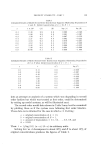
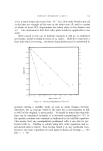
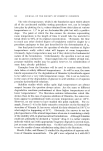
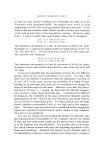
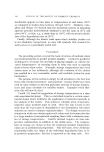
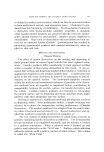
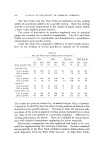
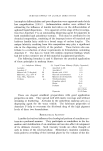
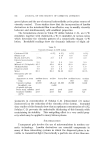
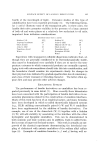
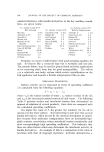
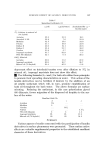
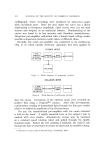
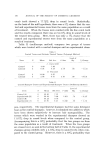
SURFACE EFFECT OF LANOLIN DERIVATIVES 167 Table V Spreading Coefficients (S) 7A(oil) -•AB(oil/water) S(calculated for 7B = 72.3 for water) 5% Solutions in mineral oil (70 Saybolt) Acetulan 32.0 21.2 19.1 Amerchol L-101 32.8 7.6 31.9 Modulan 32.5 15.0 24.8 Polylan 31.7 16.8 23.8 Ricilan B 32.6 19.1 20.6 Ricilan C 32.4 21.7 18.2 Viscolan 31.8 5.7 34.8 Isopropyl myristate 31.7 32.9 7.7 PEG 400 dilaurate 32.7 0.4 39.2 100% Materials Acetulan 32.9 17.2 22.2 Isopropyl myristate 30.9 16.7 24.7 Mineral oil (70 Saybolt) 32.4 45.3 -- 5.6 depressant effect on interfacial tension even after dilution to 5% in mineral oil isopropyl myristate does not show this effect. [•[ The following formulas (h, i and 1') for bath oils utilize these principles to promote their spreading characteristics on water. This action of the lanolin derivatives can be fortified, if desired, by the addition of an oil soluble surfactant which will, in turn, promote emulsification of bath oil throughout the bath water. The above formulas are surface orienting. Reducing the surfactant, in this case polyethylene glycol 400 dilaurate, favors migration of the dispersed oil droplets to the sur- face of the water. Emoilient Bath Oils h i j Acetulan 5% ...... Modulan 5 ...... Viscolan ... 10% ... Polylan ...... 3.5% PEG 400 dilaurate 5 5 4.5 Isopropyl myristate 25 25 37.5 Mineral oil (70 Saybolt) 60 60 54.5 SUMMARY Various aspects of studies concerned with the participation of lanolin derivatives in surface phenomena were presented. These surface active effects are valuable supplemental properties to the established emollient character of these derivatives.

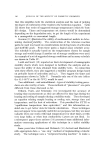
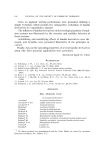
168 JOURNAL OF THE SOCIETY OF COSMETIC CHEMISTS Data on pigment wetting performance were presented utilizing a simple technique which permits the comparative evaluation of lanolin derivatives in a quantitative manner. The influence of lanolin derivatives on the rheological pattern of emul- sion systems was illustrated by the viscosity and stability behavior of these systems. Solubilizing and emulsifying effects of lanolin derivatives were dis- cussed, and formulas were presented illustrative of the principles in- volved. Finally, data on the spreading properties of several lanolin derivatives along with their practical applications were presented. (Received April 21, 1965) REFERENCES (1) Weitkamp, A. W., J. Am. Chem. Sac., 67,447 (1945). (2) Conrad, L. I., Am. Perfumer, 64, 177 (Sept. 1954). (3) British Patent//965,849 U.S. and other foreign patents pending. (4) Daniel, F. K., Q•c. Dig. Federation Paint • Varnish Production Clubs, 344, 635 (Sept. 1953). (5) Bews, I. C., and Fisk, N. R., Am. Perfumer Cosmetics, 79, 89 (Oct. 1964). (6) Conrad, L. I., Motiuk, K. and Maso, H. F., oeroc. Sci. Sect. Toilet Goods Assoc., 29, 14 (1958). (7) Conrad, L. I., Am. Perf. 71, 70 (June 1958). (8) Schulman, J. H., and Cockbain, E.G., Trans. Faraday Sac., 36,651 (1940). APPENDIX Acetulane Amerchol© L-101 Amerlate© P Modulan© Polylan© Ricilan© B Ricilan© C Solul•n© 16 Solulan© 97 Solulan © 98 Solulan© C-24 Viscolan © Waxolan© Raw Materials Used (A) Lanolin Derivatives* Acetylated lanolin alcohols Liquid multi-sterol extract lsopropyl lanolate Acetylated lanolin Lanolin alcohols linoleate Lanolin alcohols ricinoleate Acetylated lanolin alcohols ricinoleate Ethoxylated lanolin alcohols Completely acetylated, ethoxylated lanolin alcohol-esters Partially acetylated, ethoxylated lanolin alcohol-esters Ethoxylated cholesterol Lanolin oil Lanolin wax * The above products are manufactured and the Trade Marks are owned by American Cholesterol Products, Inc., Edison, N. J.
Purchased for the exclusive use of nofirst nolast (unknown)
From: SCC Media Library & Resource Center (library.scconline.org)