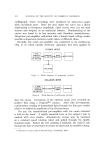
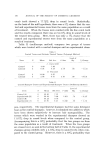
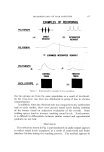
DETERMINATION OF HAIR RASPINESS 175 At least ten comb strokes at one-second intervals comprise the test. Tests have been run on wet and dry preparations. All tresses weighed 2.0 (+0.1) g. Initially, damaged (bleached) and undamaged clean tresses were compared. In a second study, shampooed tresses were compared to tresses which had been shampooed and treated with a cationic rinse. Still further, in a third study, shampooed tresses were compared to tresses which had been treated with an experimental shampoo, which had been shown in previous subjective tests to increase hair managea- bility. A cross-over of the latter tress treatment supplemented this study. All results were analyzed by a Control Data © 160-A Computer,* using statistical FORTRANt programs written by one of the authors (W. C.W.). Outcoming data from the hair combing device fit a nor- mal distribution pattern. RESULTS Figure 5 gives representative recording examples. At the top left (A) is a compressed direct readout of three tress combings using the polygraph method. It is a series of positive and negative deflections and although not utilizable for quantitative interpretation, it is evidence of noise generation. However, pen response time prevents recording frequencies above 60 cyclesf sec. If the three previous signals are each electrically integrated, the record at the top right (B) is obtained. To increase sensitivity of the method, paper speed of the strip chart re- corder may be accelerated to give an expanded integrated readout, as seen in recording C. Records of control and treated tresses appear in the lower recordings of Fig. 5. Recording D is that of a clean, dry tress examined with the polygraph method (1 comb stroke). Record F is obtained from a sim- ilar tress examined by the oscilloscope method (4_ comb strokes). If a dry tress which has been treated with a cationic rinse after shampooing is combed at the same amplifier settings used with control tresses, it may be readily observed from records E and G that the signal drop from the controls (D and F) is considerable with both methods of recording. As seen in Table I (polygraph method), control tresses were compared to cationic rinse treated tresses, which when combed with the coarse * Control Data is a trade mark of Control Data Corp., Minneapolis, Minn. • FORTRAN is an abbreviation for FORmula TRANslation and was originally developed [or International Business Machine equipment.

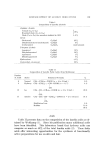
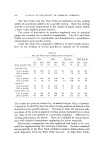
176 JOURNAL OF THE SOCIETY OF COSMETIC CHEMISTS comb teeth showed a 77.72% drop in sound levels. Statistically, on the basis of the null hypothesis, there was a 5% chance that the con- trol and experimental tresses were from the same population as a result of treatment. When the tresses were combed with the fine comb teeth and the results compared, there was an 84.31% drop in sound levds of the treated tress group. Here, there was only a 1% chance that the control and experimental tresses were from the same population as a result of treatment. Table I1 (oscilloscope method) compares two groups of tresses which were treated with a control shampoo and an experimental sham- Table I Control Tresses and Cationic-Treated Tresses (Polygraph Method) Level of Tress N Mean Std. der. t Value Sig. • Change A. Coarse teeth Control 3 4.09 1.98 ......... Cationic 3 0.91 0.24 3.70 .95 -77.72 B. Fine teeth Control 3 14.98 3.55 ......... Cationic 3 2.84 0.47 5.87 .99 --84.31 Table II Control Shampoo Tresses and Experimental Shampoo Tresses (Oscilloscope Method) Level of Tress N Mean Std. Der. t Value Sig. % Change Control (A) 6 40.81 7.21 ......... Experimental (B) 6 36.02 5.88 1.261 .70 --11.87 Control (B) 5 54.23 9.78 ......... Experimental (A) 6 51.67 4.27 0.545 .40 -- 4.73 poo, respectively. The experimental shampoo had the same detergent base as the control shampoo however, it contained two additives which have been shown subjectively to increase hair manageability. The tresses which were washed in the experimental shampoo showed an 11.87% drop in sound levels when compared to the control group. Accompanying this is a 30% probability that the two groups are from the same population as a result of treatment. When the tress groups are crossed over, as seen in the bottom half of Table II, the experimental shampoo group exhibits only a 4.73% drop in sound levels when com- pared to the control group. However, there is a 60% probability that
Purchased for the exclusive use of nofirst nolast (unknown)
From: SCC Media Library & Resource Center (library.scconline.org)