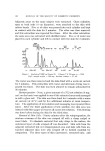
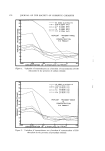
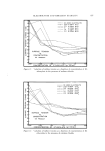
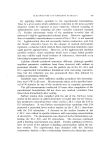
COSMETIC FILMS ON THE SKIN 155 from the cell and weighed. In this way different galvanometer readings can be related to the amount of water taken up by the cell, and a calibra- tion curve can be prepared. From a calibration curve the water vapor given up into the cell by the insensible perspiration can be determined quantitatively. In the present investigation it was more important to determine the relation between the insensible perspiration and ex- ternal factors than to determine its absolute amount. Accordingly the amounts of water vapor given up by the skin were not determined in absolute figures but in relative ones. As the measurement of insensible perspiration readings of the galvanometer movement in given time intervals were used the results can be converted into absolute amounts by using a calibration curve for the cell. Before the start of the test the subject remains in the test room for at least 30 minutes to 1 hour. Normally the forearms are used as the test area. The subject sits in a comfortable chair in front of a table and places one forearm on the table with the inner side of the forearm facing up. It is very important to make sure that the test subject is always sitting in a comfortable position during the test. For each measurement the room temperature and the relative humidity of test room are re- corded. In many cases it is also important to determine the skin temperature of the adjacent skin. First, the insensible perspiration of the untreated skin is determined during 5-15 minutes. After constant values have been obtained, the material to be tested for porosity is applied to the skin area, and then the insensible perspiration is again determined. After this determina- tion, the material is removed by gentle wiping with cotton wool, and the insensible perspiration of the uncovered skin area is rechecked. To determine the porosity of a film on the skin surface for insensible perspiration, the insensible perspiration of the uncovered skin is taken as 100%. The insensible perspiration of the skin after application of the material to the skin is calculated as per cent of the water vapor release of the uncovered skin. Human sebum was collected from several test subjects by extracting their skin with ether and ethanol. RESULTS AND DISCUSSION Figure 1 represents the result of the analysis of the natural mois- turizing factor extracted from living human skin as determined by column and paper chromatography. Based on this analysis a NMF was synthesized. The ability of stratum corneum to pick up moisture

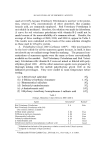
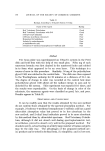
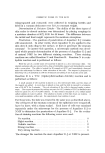
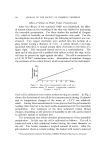
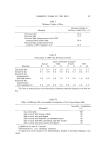
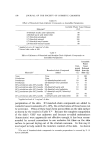
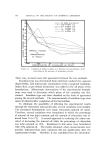
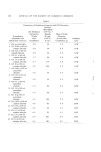
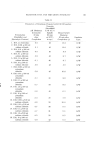
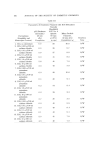
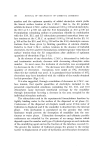
156 JOURNAL OF THE SOCIETY OF COSMETIC CHEMISTS was studied on several specimens of living human skin: untreated stratum corneum skin freed from NMF by extraction and extracted skin reimpregnated with natural or synthetic NMF. The results (Table I) of the investigation of the moisture uptake of differently treated skin cells represent averages of 171 single measurements on a total of ten different human subjects ranging in age from 13 to 75 years. The results suggest that synthetic NMF (Aqualizer E-J) can replace natural NMF and restores the horny layer's moisture uptake completely. The results (Table II) of the study of the penetration of synthetic NMF into the stratum corneum of the skin, using the ninhydrin (N) and TTC (R) tests, are based on the average values of 147 single meas- urements on a total of ten human subjects ranging in age from 13 to 75 years. Aqualizer E-J evidently penetrates deeply (Table II) into the stratum corneum of the skin. It reacts as strongly in the lowest tested horny layer of the extracted and reimpregnated skin as on the untreated skin. If human sebum is applied to a skin area in an amount of 1 mg/cm 2, the measured insensible perspiration was 90 to 95% of that of the un- covered skin. Results of insensible prespiration measurements on skin covered with other fats are shown in Table III for comparison. The application of some typical materials used in cosmetic prepara- tions can decrease the insensible perspiration of the skin when applied in tile amount of 1 mg/cm 2. If more of these materials were applied to the skin, the depression of the insensible perspiration would be expected to increase. On the other hand, the results of these experi- ments show that human sebum does not depress the insensible perspira- tion. What has been shown here for human sebum has been demon- strated by Weitzel and co-workers (16) for the preen gland oil of ducks. Weitzel and his group have studied the relationship between the porosity of the surface fats to their chemical composition. These researchers have found that the presence of branched-chain aliphatic compounds in surface fats is responsible for their porosity. Amongst the isolated aliphatic branched-chain compounds were acids, alcohols, esters of these, as well as esters of branched-chain compounds with straight-chain com- ponents. Recently Reinertson and Wheatley (19) and Nicolaides and Kellum (20) also found branched-chain compounds in human sebum. Table IV shows a few examples of results of determinations of insensible perspiration after application of 1 mg/cm • of different branched-chain compounds to the skin. As can be seen, the films are porous and do not impede insensible
Purchased for the exclusive use of nofirst nolast (unknown)
From: SCC Media Library & Resource Center (library.scconline.org)