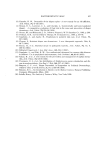
BACTERIOSTATIC SOAP 167 (3) (4) (5) (6) (7) (8) (9) (10) (11) (12) (13) (14) (15) (16) Kaessler, H. W., Dermatitis of the diaper region--A new remedy for an old affliction, Arch. Pediat., ?4, 47-50 (1957). Benson, R. A., Lawrence, C. A., and Chavkin, L., Commercially and home-laundered diapers. A comparative evaluation of their role in the cause and prevention of diaper dermatoses, Arch. P ediat., ?3,250-58 (1956). Greene, M., and Rich•nond, J. B., Pediatric Diagnosis, W. B. Saunders Co., 1962, p. 206. Periman, H. H., Current Pediatric Therapy, W. B. Saunders Co., 1966, p. 579-81. Lipschutz, A., and Agerty, H., Prophylaxis in pediatric skin care, Arch. Pediat., ?9, 257 (1962). Clyman, S., Resistant diaper area dermatoses: A new therapeutic approach, Skin, 3, 86-7 (1964). Seneca, H., et al., Bacterial urease in pathogenic bacteria, Arch. Pathol., 74, No. 6, 489-94 (1962). Editorial, Diaper rash, J. Am. Med. Assoc., 165,254-5 (1957). Lipschutz, A., and Fitti, R. M., New antibacterial detergent for common skin diseases in children: Use in prophylaxis and treatment, Arch. Dermatol., 68, 83-85 (1953). Kahan, H., et al., A new remedy for the prevention and management of napkin derma- titis, Arch. Pediat., 73,125-9 (1956). Thompson, D. J., et al., Sex distribution of Staphylococcus aureus colonization and dis- ease in newborn infants, New Engl. J. Med., 269,337-41 (1963). Burgoon, C. F., et al., Diaper Dermatitis, in Symposium on Pediatric Dermatology, Pediatric Clinic of North America, 8, No. 3,835-56 (1956). Batsoon, H. C., An Introduction to Statistics in the Medical Sciences, Burgess Publishing Company, Minneapolis, Minn., 1956. Scheffe, Henry, The Analysis of Variance, Wiley, New York, 1959.

J. Soc. Cosmetic Chemists, 18, 169-189 (Mar. 4, 1967) The Relationship Between Effects Due to Electrolytes Emulsion Stability Surface and AARON MILLER, B.S.* Presented May 10, 1966, New York City Synopsis.--It is shown that the addition of dectrolytes to emulsions can alter specific pa- rameters which, in turn, can be related to emulsion stability. A mechanism for the action of specific electrolytes on emulsion systems containing certain nonionic polyoxyethylene ethers as emulsifiers is postulated. The surface chemistry effects which result from the included salts are discussed. INTRODUCTION The cosmetic chemist may often be required to formulate an emulsion containing an electrolyte. A wide variety of suitable emulsi- fiers is available for this purpose. However, the presence of electrolytes, even in small quantities, will often cause changes in the surface chemistry of commonly employed emulsifiers and seriously affect the stability of the product. The difficulties created by the inclusion of electrolytes may be elusive. A nonionic emulsifier, e.g., an ethylene oxide condensate, is often selected to overcome the formulation problems which may arise due to the presence of electrolyte. However, this approach, too, must be carefully considered. Although the literature concerning the effect of electrolytes on emulsifiers is extensive, the investigators generally * Kolar Laboratories, Inc., 1123 W. Jackson Blvd., Chicago, Ill. 60607. 169
Purchased for the exclusive use of nofirst nolast (unknown)
From: SCC Media Library & Resource Center (library.scconline.org)