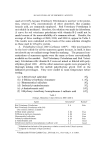
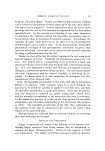
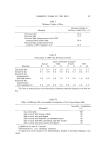
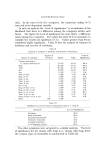
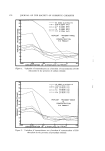
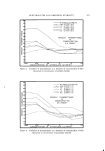
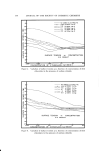
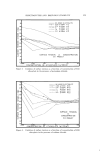
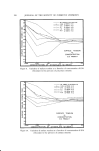
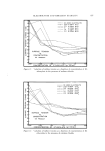
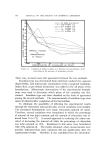
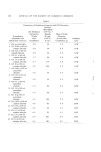
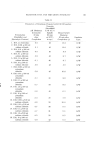
EVALUATION OF SUNSCREEN AGENTS 145 used at 0.015% because Veterinary Petrolatum is used per se for protec- tion, whereas 10% concentrations of other absorbers, like p-amino- benzoic acid, are commonly employed. Red Veterinary Petrolatum is not soluble in methanol therefore, the solution was made in chloroform. A curve for red veterinary petrolatum with vitamin B-2 could not be made because of the nonavailability of a common solvent. Results, the average of three readings at 2900, 3100, and 3300 A, appear in Table I. The results were calculated on the basis of the same solution strengths as those used in Urbach's system. 5. Polyethylene Glycol 1500 (Carbowax 1500'): This was found to be the best vehicle for all the sunscreen agents because, in itself, it does not absorb any uv radiant energy from the sunlamp. The prepared con- centrations of sunscreen agents were the same as those conventionally available on the market. Red Veterinary Petrolatum and Red Veteri- nary Fetrolatum with vitamin B-2 were not mixed or diluted with poly- ethylene glycol 1500. All the other sunscreen agents were prepared by thorough mixing with the melted polyethylene glycol 1500 at the indicated percentages. They were cooled to room temperature before testing. (a) 2-Ethyl hexyl salicylate 5% (b) 2-Ethoxy-p-methoxy cinnamate 1.5% (c) Homomenthyl salicylate 3% (d) Isobutyl-p-aminobenzoate 5% (e) p-Aminobenzoic acid 10% (f) 2-Hydroxy-4-methoxy benzophenone-5-sulfonic acid 10% Table I Average Absorption Values Between 2900-3300 A Agent Absorption a Rating ø 3.0 Fair Red Veterinary Petrolatum Red Veterinary Petrolatum with B-2 (No common solvent available) 2-Ethyl hexyl salicylate 2-Ethoxy-p-methoxy cinnamate Homomenthyl salicylate Isobutyl-p-aminobenzoate p-Aminobenzoic acid 2-Hydroxy-4-methoxy benzophenone-5-sulfonic acid 0.85 Poor 0.59 Poor 0.54 Poor 2.25 Fair 3.5 Good 4.5 Good Calculated on the basis of the percentage solution as used in the Urbach system. Assigned on the basis of light absorbed. * Trade •nark of Union Carbide Corp., 270 Park Ave., New York, N.Y. 10017.

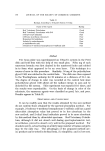
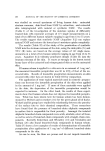
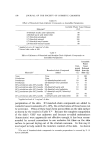
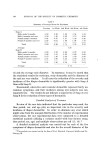
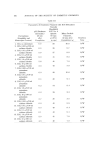
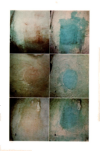
146 JOURNAL OF THE SOCIETY OF COSMETIC CHEMISTS Table II Ratings According to Urbach's System Testing Name of the Agent Rating Red Veterinary Petrolatum Red Veterinary Petrolatum with B-2 2-Ethyl hexyl salicylate 2-Ethoxy-p-methoxy cinnamate Homomenthyl salicylate Isobutyl-p-aminobenzoate p-Aminobenzoic acid 2-Hydroxy-4-methoxy benzophenone-5-sulfonic acid Good Oood Fair Poor Poor Poor Fair Fair Method The brass plate was superimposed on Urbach's system in the Petri dish and held firm with the help of two small pins. Fifty mõ of each sunscreen formula was first daubed in the numbered holes and rubbed in to form what appeared to be an even layer. This technique is a source of error in this procedure. Similarly, 50 mg of the polyethylene glycol 1500 was rubbed in the central hole. The dish was then exposed to the Westinghouse suniamp for 20 minutes at a distance of 25.5 cm. The degree of change in color was recorded at the central hole since polyethylene glycol 1500 allows all the radiant energy to pass and be absorbed by the system. This experiment was repeated five times, and the results were reproducible. On the basis of change in color of the substrate, the sunscreen agents were classified as good, fair, and poor. Results appear in Table II. DISCUSSION AND CONCLUSION It can be readily seen that the results obtained by the new method do not confirm those obtained by the spectral absorption method. For example, 2-hydroxy-4-methoxy benzophenone-5-sulfonic acid has a good ultraviolet absorption value but proved to be less absorbant by the new method, and 2-ethyl hexyl salicylate proved to be more absorbant by this method than by ultraviolet spectrum. Red Veterinary Petrola- tum, although it did not absorb well during spectrophotometric test, nevertheless, proved to absorb very well in the proposed method. For absolute surety, actual testing on a fairly large number of human subjects may be the only way. The advantages of the proposed method are: (a) product can be tested in its final form, (b) simplicity, and (c) low cost.
Purchased for the exclusive use of nofirst nolast (unknown)
From: SCC Media Library & Resource Center (library.scconline.org)