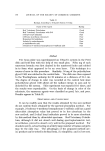
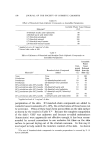
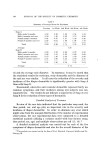
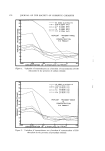
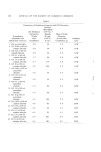
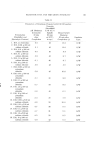
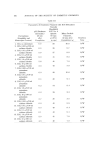
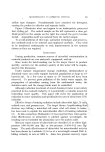
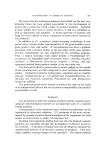
182 JOURNAL OF THE SOCIETY OF COSMETIC CHEMISTS Table III Formulation (Emulsifier and Electrolyte Content) Parameters of Emulsions Prepared with El5 Ethoxylate Viscosity (Brookfidd pH (Beckman LVF No. 4 Zeromatic) Spindle Mean Particle 30 min 60 rpnl Diameter, after at 25øC 30 min after Completion in cps) Completion (u) Emulsion Type 1. El5, no electrolyte 2. El5, 0.001 g/100 ml sodium chloride 3. El5, 0.01 g/100 ml sodium chloride 4. El5, 0.1 g/100 ml sodium chloride 5. El5, 1.0 g/100 ml sodium chloride 6. El5, 10 g/100 ml sodium chloride 7. El5, 0.001 g/100 ml potassium chloride 8. El5, 0.01 g/100 ml potassium chloride 9. El5, 0.1 g/100 ml potassium chloride 10. El5, 1.0 g/100 ml potassimn chloride 11. El5, 10 g/100 ml potassium chloride 12. El5, 0.001 g/100 ml calcium chloride 13. El5, 0.01 g/100 ml calcium chloride 14. El5, 0.1 g/100 ml calcium chloride 15. El5, 1.0 g/100 ml calcium chloride 16. El5, 10 g/100 ml calcium chloride 6.0 6.0 5.9 6.0 5.8 55 60 61 62 62 57 6.0 6.0 6.1 5.0 4.5 aa •0.0 o/w as 9.7 o/w a7 8.9 o/w 41 8.5 O/W 40 7.9 O/W 43 .5.8 O/W 29 10.0 O/W 3o 9.7 o/w ,34 9.4 O/W a8 8..5 o/w 50 5.0 o/w 45 9.8 O/W 49 9.4 0/W 43 9.1 O/W 41 7.9 O/W 40 7.0 O/W

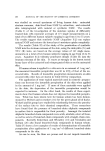
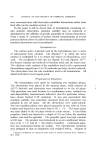
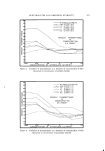
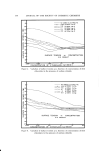
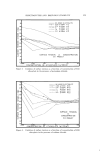
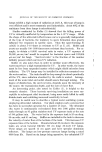
ELECTROLYTES AND EMULSION STABiLiTY 183 By applying Stokes' equation to the experimental formulations, those in a given series which exhibited a reduction in the mean particle diameter would be expected to have relatively reduced creaming or sedimentation rates, assuming all other variables remained constant (7). Further microscopic study of the emulsions revealed that all possessed a highly agglomerated internal phase. However, agglomera- tion at emulsifier concentrations in excess of the C.M.C. is not unusual (8). Agglomeration does not necessarily hasten coalescence, and Van der Waals' attractive forces (in the absence of marked electrostatic repulsion, a situation which exists in these experimental emulsions) cause rapid particle agglomeration. However, as the agglomerated emulsion particles coalesce, those emulsions which have a large initial particle size may exhibit rapid visual evidence of coalescence, observable as an increasing transparent surface layer. Calcium chloride produced somewhat different, although parallel, emulsion parameter variations from those observed with sodium or potassium chloride. In this case the particle size in the ES, El0, and El5 experimental formulations diminished with increasing concentra- tion, but the reduction was less pronounced than that induced by sodium or potassium chloride. Emulsion type, where sufficient stability permitted this determina- tion, was O/W in all cases. Measurements taken at the specified inter- val of 30 minutes by any of the methods were in complete agreement. The pH measurements conducted 24 hours after completion of the experimental formulations did not show any marked variations from those taken immediately after cooling. Surface tension data compiled with the aid of the DuNouy tensi- ometer in the absence of added electrolyte revealed that the E5 ethoxy- late produced a somewhat lower value (at the C.M.C.) than the El0 or El5 ethoxylates. It was further ascertained that emulsions with ]5 10 possessed a somewhat lower surface tension (at the C.M.C.) than those with the El5 ethoxylate. A decrease in the surface tension at the C.M.C. was evident in specific instances with increasing concentrations of electrolyte. The phenomenon was observed in the formulations con- taining the El5, El0, and E5 ethoxylates. The decrease continued until a limiting concentration was added. Further additions of electro- lytes (in excess of the optimal or limiting concentration) raised the sur- face tension. The experimental data obtained with the DuNouy tensiometer disclose a direct relationship between the ethoxylate series
Purchased for the exclusive use of nofirst nolast (unknown)
From: SCC Media Library & Resource Center (library.scconline.org)