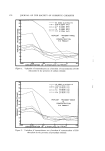
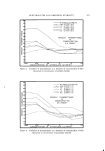
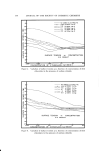
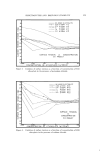
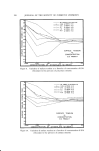
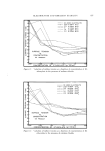
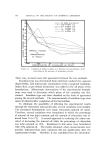
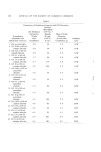
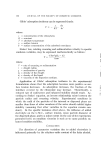
188 JOURNAL OF THE SOCIETY OP COSMETIC CHEMISTS hahted by added electrolyte to as great an extent as is observed with electrolytes which do not release excess hydrogen ions. Even though emulsion and surface parameter variations indicate increased emulsion stability with the El5, El0, and E5 ethoxylates in the presence of added electrolyte, the nature of the variations are such that formulations which contain sodium or potassium chloride may have greater long range emulsion stability than those containing calcium chloride. In this instance, the hydration of the polyvalent calcium ion induced parameter variations which are associated with diminished stability relative to those created by potassium or sodium chloride. SUMMARY The measurable effect of added electrolyte on emulsions containing ethylene oxide-fatty alcohol derivatives as primary emulsifiers depends on several factors and their interrelation. 1. The interaction of the electrolyte with the water molecules is an important factor. Added electrolyte disrupts ethoxylate-water mole- cule interactions. The presence of ions causes the water molecules to be drawn toward themselves. Hydrogen bonding among neighboring water molecules and hydration of the ethylene oxide groups of the ethoxylate molecules are inhibited. Consequently, the effective hydra- tion energy and solubility of the ethoxylate are diminished. 2. Ethoxylate hydration energy will help determine the extent of adsorption, particle size, C.M.C., and surface tension at the C.M.C. The values of these factors, as determined by inherent or electrolyte- induced ethoxylate hydration energy, play a decisive role in the emulsion's resistance to coalescence. By applying the numerical values for the above factors to Gibbs' adsorption isotherm and Stokes' cream- ing and sedimentation equation, the relative stability of the experi- mental formulas to coalescence can be predicted. 3. The quantity of electrolyte introduced into the experimental emulsions containing the El5, El0, and E5 ethoxylates determines emulsion stability. The presence of added electrolyte will reduce the hydration energy of the ethoxylate in a direct quantitative relationship. In those instances in which hydration energy is too great to be con- sistent with maximum interfacial adsorption, interfacial coverage (and as a consequence emulsion stability) increases with increasing amounts of electrolyte. 4. The nature of the electrolyte is also an important factor in pro- jected emulsion stability. The inclusion of sodium or potassium chloride

ELECTROLYTES AND EMULSION STABILITY 189 in some cases induced greater positive emulsion parameter variations (indicative of possible increased long range stability) than those observed upon addition of calcium chloride. The ions released by hydrolysis of calcium chloride give rise to excess protons. It is postulated that protons are not strongly adsorbed at the emulsion interface and do not compete with the ethoxylate for interfacial sites. However, in formula- tions containing the El5, El(), and E5 ethoxylates calcium chloride does not produce emulsion parameter variations which indicate a degree of adsorption as great as that induced by optimal quantities of sodium or potassium chloride. ACKNOWLEDGMENT The author of this paper wishes to express his gratitude to William Moll. Mr. Moll's illustrations have been invaluable in the preparation of portions of this paper. (Received September 12, 1966) (2) (a) (4) (6) (7) (8) (9) (lo) (•) (12) REFERENCES Harkins, W. D., The Physical Chemistry of Surface Films, Reinhold Publishing Corp., New York, 1952. Matijevic, E., and Pethica, B. A., The properties of ionized monolayers, Trans. Faraday Soc., 54, 1382 (1958). Van Voorst Vader, F., Adsorption of detergents at the liquid-liquid interface, Trans. Faraday Soc., 56, 1067 (1960). Becher, P. J., Non-ionic surface-active compounds determination of critical micelle concentration by a spectral dye method, J. Phys. Chem., 66, 374 (1962). Schmolka, I. R., and Raymond A. J., Micelle formation of polyoxyethylene poly- oxypropylene surfactants, unpublished, Wyandotte Chem. Corp., (1965). Miller, A., The effect of ethoxylated fatty alcohol combinations on emulsion stability, Proc. Sci. Sect., Toilet Goods Association, 43, 28 (1965). Martin, E. W., and Cook, E. F., Remington Practice of Pharmacy, Mack Prtg. Co., Easton, Pa., 1956, pp. 186-199. Riegelman, S., New data on determining emulsion stability, Am. Perf., 77, 59 (1962). Osipow, L. I., Surface Chemistry, Reinhold Publishing Corp., New York, 1962, pp. 295-341. Abu-Hamdiyya, M., The effect of urea on the structure of water and hydrophobic bonding, J. Phys. Chem., 69, 2720 (1965). Lorenz, J., Specific adsorption isotherms of thiocyanate and hydrogen ions at the free surface of aqueous solutions, J. Phys. Chem., 54, 685 (1950). Ariymna, A., Theory of surface tension of aqueous solutions of inorganic acids, Bull. Chem. Soc. Japan, 12,109 (1937). Anderson, C. A., and Truter, E. V., Hydrolysis of wax-esters in emulsions, J. Soc. Cosmetic Chem., 15,447 (1965).
Purchased for the exclusive use of nofirst nolast (unknown)
From: SCC Media Library & Resource Center (library.scconline.org)