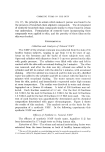
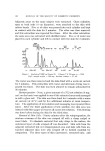
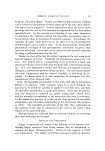
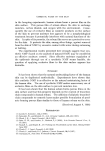
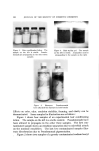
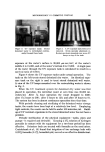
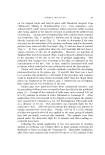
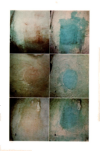
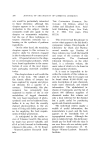
MICROBIOLOGY IN COSMETIC TESTING 195 '• :•..•z . • •',.•'" • :&': :{ •- :': ' ...... """'i: •- ' .... :.: ....... ,. :. •,• . , .... .. ..•½:.. • •5:. ß .•. •, .•a '. ß :.½•- •?:::' • .• ' Figure 4. UV exposure tanks. Stored ddonized water is redralated continu- ously through these knks .• : ß ß .. Figure 5. A UV exposure tank with cover removed. Seven specular aluminum re- fleetors are shown mounted over seven UV lamps on top of the tank exposure at the water's surface is 26,000 t•w-sec/cm " at the water's middle it is 18,000, and at the water's bottom it is 17,000. A single pass of the water through the UV exposure tank is calculated to result in a survival ratio of 0.0016. Figure 4 shows the UV exposure tanks under actual operation. The tank on the left treats stored deionized city water. An identical expo- sure tank on the right is used to treat stored deionized well water. A view of the UV lamps mounted over the recirculating water is shown in Fig. 5. When the UV treatment system for deionized city water was first placed in operation, the microbial count at zero time was 38,000 mi- crobes/mi. After •/• hour operation the count dropped to 3300 after 1•/• hours to 390 after 2 hours to 120, and after 18 hours to 81. The system has been in almost continuous operation since that time. With periodic cleaning and sterilizing of the deionized water storage tanks, the counts have been kept at a relatively low level. Employing tight controls, the counts can be held to under 100 microbes/mi. Build- up of UV resistant organisms in the stored deionized water has not been a problem. Periodic sterilization of the physical equipment--tanks, pipes and pumps--is required and desirable. Keeping a 2% solution of hydrogen peroxide in contact with the equipment for a two-hour period has been effective. Deionizer beds are treated with formalin as the need arises. Cruickshank et al., (6) found that irrigation of ion exchange beds with 0.25% formalin (0.1% formaldehyde) served as an effective disinfectant.

196 JOURNAL OF THE SOCIETY OF COSMETIC CHEMISTS PRESERVATION Even with good sanitation practices, cosmetics must be preserved to cope with contamination encountered during production, packaging, and normal usage. As other workers in the field of cosmetic preservation agree, test preservative systems must be evaluated in finished product formulations before final selection of a preferred system is made. A useful technique for measuring the relative antimicrobial activity of various preservative system candidates is the inoculation of varying concentrations of selected test organisms into the test systems. This technique is predicated on the hypothesis that the higher the concentra- tion of selected microbes a test system can inactivate the greater the efficacy of the system. This titration technique for evaluating the efficacy of preservation systems is illustrated in an application to a hair-conditioning lotion. The product was an o/w emulsion having a pH between 3.25 and 4.25 nonionic emulsifiers were utilized in the formula at a concentration of approximately 4%. Illustrative of a few of the preservatives evaluated in this product were: (a) 0.1% methyl p-hydroxybenzoate (MP), (b) 0.2% MP, and (c) 0.2% benzoic acid. It should be understood that these compounds are but a small sample of those normally employed in screening preserva- fives. Among the test organisms inoculated into the test systems was a Pseudomonad that had been isolated from a contaminated experimental batch of the product preserved with 0.1% MP. A pure culture of the test Pseudomonad was taken from a nutrient agar slant and allowed to propagate for 24 hours at 30-32øC in nutrient broth. The resulting suspended culture was centrifuged and washed three times with buffered distilled water (pH 7.2). Serial dilutions of the washed culture were prepared in buffered distilled water (pH 7.2). One ml aliquot of each dilution were inoculated into 9 ml aliquots of each preserved product. Sterility testing of the inoculated product samples showed that 0.1% MP inactivated levels of the test Pseudomonad up to about 10S/ml of product. The product with 0.2% MP inactivated dosages up to about 107. The system containing 0.2% benzoic acid appeared bactericidal against the highest inoculum tested, i.e., 10O/ml of product. Under practice conditions, Pseudomonad contamination was a re- curring problem with the product containing only 0.1% MP. The product containing 0.2% benzoic acid has consistently been produced in a sterile condition.
Purchased for the exclusive use of nofirst nolast (unknown)
From: SCC Media Library & Resource Center (library.scconline.org)