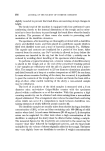
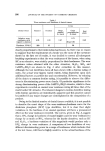
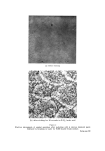
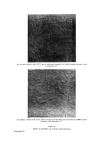
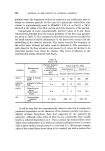
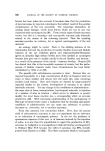
402 JOURNAL OF THE SOCIETY OF COSMETIC CHEMISTS position where the separation of the two surfaces is just sufficiently wide to accept an abrasive particle. In the case of a spherically ended fibre, this volume is approximately equal to 10/9•Rd 2, if R d, so that [t •_ 7R/d, where R is the radius of the fibre section and d the diameter of the particle. Comparisons of some experimentally derived values of [I and those obtained theoretically from the known geometry of the fibre and particles are given in Table II. The calculated values have been corrected to allow for the small amount of elastic deformation of the fibre-tooth contact and the embedding of the abrasive particles. The former extends the boundary of the active zone, whereas the latter tends to diminish it. This correction is quite large for the finer abrasives and causes the [t values for dentine to be somewhat greater than those for enamel. This trend is followed in the experimental results obtained with A120 3. Table II Values of [I Particle diameter I Values of [i (R= 100g) (diameter Manufacturer corresponding Experimental Theorical Abrasive and to mean volume, / /-- product (•3)• all particles 1 g Enamel Dentine Enamel Dentine __ A1203 Griffin & George I ($/20) $ g ! 130 168 290 '• $90 CattPO4. Albright & Wilson _ 21-I20 (SM) 12 g $0 30 59.0 59.5 , CaCO 3 Gibbs Proprie- taries (Waterworks 15 I1 8 8 47.5 48.0 Chalk) . -- SiC Carborundum Company (2 - 20 it) (400 - 13) (650 - 35) (700) It will be seen that the experimentally derived values for D confirm the predicted dependence on the diameter of the abrasive particle, but show a slightly stronger dependence than that suggested by the spherical tip geometry. Although other forms of fibre tip are conceivable, they usually lead to a reduced dependence on d. Thus a conical tip would yield [t values which were independent of d, whilst an inclined cylindrical form in contact with a plane surface would cause D to vary with d-L Microscopic examin- ation of the actual fibres shows them to be rounded, but with a surface that

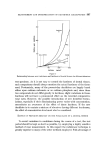
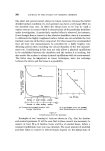
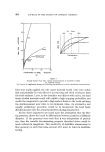
MEASUREMENT AND INTERPRETATION OF DENTIFRICE ABRASIVENESS 403 might be better described as an oblate spheroid. As the fibres will be in- clined to the tooth surface when brushing, the effective radius of the tip will be slightly less than that of the fibre cross-section. This may explain why the experimental values of • are smaller than the theoretical values. It is also likely that the diverging region of the trapped volume will be less efficient in causing particle abrasion than the converging leading zone and this factor alone could reduce all the theoretical • values by a half (tiddly- wink action). Bearing these factors in mind, the agreement between theory and experiment is remarkably good. It is interesting to note that over the usual dentifrice concentration range employed in oral brushing, approximately 1-5 particles are trapped by each fibre, assuming particle sizes ranging from 14-10 it. Thus one sweep of a brush containing 1,500 fibres might be expected to cause the whole surface to be traversed once by abrasive matter and 15 strokes should be adequate to remove a soft overlayer of 10-50 It thickness. The above theoretical analysis applies only to a mono-disperse system where all the particles are assumed to be of approximately equal size and abrasiveness. In practice, dentifrices contain abrasive particles of a fairly wide range of diameters and, in some cases, mixtures of compounds of sharply contrasting abrasiveness. The combination of these two factors can lead to a variation of • with concentration level. Consider, for instance, a mixture of finely divided and coarse particles of similar abrasiveness. Initially at low concentrations the finer matedhal will dominate the wear rate/concentration characteristic, but as the dentifrice concentration is increased, the coarser material will prevent the fine abrasive playing a major role and • will decrease. Such an effect is probably occurring with the SiC abrasive used to obtain the result shown in Fig. •. In this case there was a wide range of particle sizes present and a simple exponential function did not adequately describe the results. Initially, the magnitude of [I was in accord with the value one might associate with the very finely divided component of the abrasive but this slowly decreased to 13 which is a value more typical of coarse particles of about 14 I•. These results do not take into account the actual concentrations of the various components and thus tend to give rather low values for •. In practice, advantage could be taken of this ability of a dentifrice to make use of different particle sizes at different concentration levels. Thus a dentifrice, composed of a mixture of a very fine hard abrasive compound and a coarse soft matehal, would exhibit a discriminating power that varied with the actual concentration of the dentifrice being used. If such a denti-
Purchased for the exclusive use of nofirst nolast (unknown)
From: SCC Media Library & Resource Center (library.scconline.org)