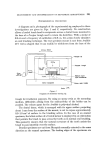
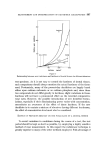
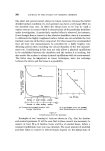
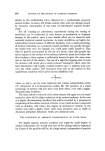
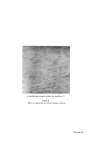
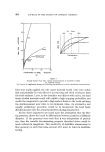
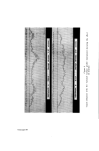
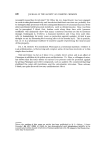
404 JOURNAL OF THE SOCIETY OF COSMETIC CHEMISTS 5,0 4.0 2.0 3 o IO 20 30 Concentral'ion of solids, %(vol/vol) (a) Oral Range Lower Test Concentration Upper _ (b) Figure 7 Dental tissue wear rate versus concentration of dentifrice solids (a) Typical curves (b) Curves to emphasise danger of selecting an arbitrary level of dentifrice concentration frice were orally applied, the soft coarse material would come into action first and probably be very effective in removing soft thick overlayers from the teeth surfaces. Later, as the dentifrice was diluted with saliva, the hard finely divided material would still exhibit a high trapping probability and enable the compound to provide a high surface lustre to the teeth and keep the dentine/enamel wear ratio to its minimum value. An alternative and equally satisfactory procedure would be to incorporate the hard finely divided abrasive into the actual brush fibres during manufacture. All the above arguments are based upon the assumption that the fibre tip geometry allows the brush to differentiate between particles of different diameter. If the geometry were such that • was independent of particle size, then the variable discriminating property described above would be much reduced in magnitude. This sensitivity of dentifrice abrasiveness to fibre geometry is such that some account of it must be taken in dentifrice testing.

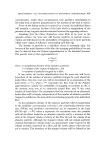
MEASUREMENT AND INTERPRETATION OF DENTIFRICE ABRASIVENESS 405 It is equally apparent that, in dentifrice testing, proper consideration must be given to the range of concentrations covered during oral usage. The common practice of comparing dentifrices at some arbitrary concentration level cannot be justified in the light of the present experimental data. For example, examination of Fig. 7(b) clearly shows that although two denti- frices with characteristics such as 'a' and 'b' are directly comparable at any concentration level, this situation will rarely arise and, in most cases, one will be attempting to compare dentifrices with characteristics such as 'b' and 'c'. Furthermore, although many of the dentifrices investigated show a gradually saturating wear characteristic, some dentifrices were found to exhibit a sharp falling off in abrasivehess at high concentration levels. This effect could have arisen from the interplay of a mixture of hard and soft abrasives, but it is generally felt to be due to the stiff paste-like qualities of these dentifrices preventing full tissue coverage during brushing. The only satisfactory solution to this problem is to resort to an integrated wear test, which takes full account of the changes in dentifrice abrasiveness over the range of concentrations normally experienced during oral brushing. As the dentifrice concentration is not itself linearly related to the number of brush strokes, this test must take the dentifrice dilution function into account. If one assumes that saliva is produced at a constant rate under the stimulation of the brushing action, then the relationship between con- centration, C, and number of brush strokes, S, will be of the form C=a/ (l+bS), where a and b are constants. a is determined by the initial con- centration of the dentifrice, which is generally less than 100% owing to the habit of wetting the brush before use, whilst b reflects the rate of saliva production. For practical testing purposes, the integrated dentifrice abrasiveness is best obtained by simply allowing the dentifrice to be continuously diluted in a fashion that reflects the oral condition, but adjusting the rate of dilution to give the required final concentration, usually about 20% (w/w) (9). The initial concentration is similarly adjusted to correspond to a wetted brush. As the continuous addition of diluent is not easy to arrange in practice, a satisfactory alternative is to add the liquid at a few set times during a test. A suitable liquid, having a similar viscosity to human saliva, is obtained by adding a small quantity of CMC to water (10). The level of radioactivity of the slurry at the end of the test then yields a measure of the integrated dentifrice abrasiveness under oral conditions of usage.
Purchased for the exclusive use of nofirst nolast (unknown)
From: SCC Media Library & Resource Center (library.scconline.org)