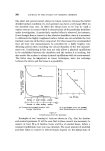
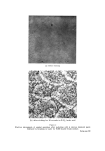
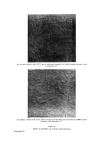
406 JOURNAL OF THE SOCIETY OF COSMETIC CHEMISTS CONCLUSIONS 1. It has been shown that the radiotracer technique can provide an extremely rapid assessment of the abrasiveness of a dentifrice and can be made so sensitive that it is possible to measure transient wear rates arising from changes in surface contour or environment of the dental tissue. If necessary it is possible to measure the wear caused by one or two strokes of a brush on dentine polished with a commercially available dentifrice. 2. The results obtained with different tissues suggest that their wear behaviour is similar to pure metals or other materials in that their abrasive wear resistance is proportional to indentation hardness when very hard abrasive compounds are used. In other cases where the dentifrice abrasive has a hardness comparable to that of the tissues, the wear resistance increases rapidly as the tissue hardness approaches that of the abrasive and the dentifrice exhibits a strong discriminating action towards different tissues. This situation applies to most proprietary dentifrices and accounts for the large dentine/enamel wear ratios and the sensitivity of enamel wear resistance to its hardness. The possibility of much harder abrasive compounds being used in dentifrice formulation makes it imperative to incorporate into any test specification the requirement that enamel as well as dentine be used as a test material. Failure to do this could lead to the production of dentifrices which were excessively abrasive to enamel. 3. A detailed examination of the tissue wear/dentifrice concentration curves suggests that the form of this relationship is closely associated with the brush fibre tip geometry. In the case of mono-disperse systems the controlling factor appears to be the ratio of the volume of the active col- lection region of the fibre tip to that of an abrasive particle. However, in most practical cases, the former increases with particle diameter and the sensitivity of the wear/concentration curves to the size of the abrasive particles is reduced. As a result the level of dentifrice concentration at which tissue wear saturation occurs varies but slowly with particle diameter. The effect could be enhanced by a change in tip geometry, but most commonly used geometrical forms tend to minimise it. This variability stresses the need to standardise brush fibre geometry in dentifrice testing and to employ an integrated test to take account of the wide range of dentifrice concentrations that occur in oral use. The fact that some dentifrices often show a marked falling off in abrasiveness when used at high concentrations strengthens the case for this form of assessment.

MEASUREMENT AND INTERPRETATION OF DENTIFRICE ABRASIVENESS 407 The above considerations also clearly show that lapping pad machines should be discouraged, since they cannot reproduce the interaction between the brush fibres and the dentifrice abrasives. 4. It has been well established that in situations where there has been a change in environment or surface contour, it is important to carry out a conditioning run prior to any test evaluation of a tissue/dentifrice com- bination. This precaution is particularly necessary when a radiotracer technique of wear measurement is employed, since the number of brush strokes required to obtain a measurable amount of wear is small in com- parison to other test methods. This high sensitivity of the radiotracer technique makes it particularly valuable for future investigations of the 'running in' phenomenon. ACKNOWLEDGEMENTS This paper is published by permission of the Director of the National Engineering Laboratory, Ministry of Technology. It is Crown copyright and is reproduced by permission of the Controller of H.M. Stationery Office. The authors wish to express their thanks to Professor H. W. Wilson for the irradiation facilities offered at the Scottish Research Reactor Centre. (Received.' l•tth November 1966.) REFERENCES (1) Souder, W. and Schoonover, I. C. J. Am. Dental Assoc. 9•4 1817 (1037). (2) Kitchen, P. C. and Robinson, H. B.G. J. Dental Research 9.0 501 (1048). (3) Wright, H. N. and Fenske, E. L. J. Am. Dental Assoc. •4 1889 (1037). (4) Ray, K. W. and Chaden, H. C. Dental Cosmos 75 1070 (1055). (5) Grabenstetter, R. J. et al. J. Dental Research a? 1060 (lOSS). (6) Collie, C. YI. et al. Proc. Phys. Soc. $8/k 282 (1980). (7) Huysen, Von G. and Boyd, T. M. J. Dental Research 31 875 (1952). (8) Khruschov, M. M. and Babichev, M. A. Russ. Eng. J. 43 (Issue 6), (1964). (9) Manly, R. S. J. Dental Research 9,• 59 (1942). (10) Tomlinson, K. Private Communication (1966). DISCUSSION MR. 1 q'. R. RIDGWAY: You have described the wear rates of enamel in terms of particle size and hardness, but you have not considered the reactivity of the materials with the enamel itself. You irradiated the teeth producing active phosphorus. It seems to me that all you may have described is the solubility effects of the materials on the phosphorus in the enamel, and that the three curves in _Fig. 7, excluding that of silicon carbide, just measure the reactivity or solubilising effect of the abrasive on the phosphorus in the enamel. If you are going to carry out a comparison in that way
Purchased for the exclusive use of nofirst nolast (unknown)
From: SCC Media Library & Resource Center (library.scconline.org)