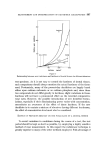
MEASUREMENT AND INTERPRETATION OF DENTIFRICE ABRASIVENESS 411 this can really only be ascertained by carrying out the test with different periods of brushing and extrapolating the results back to zero brush strokes. If sedimentation is occurring then this will show itself by producing a gradually increasing wear rate as the number of brush strokes diminishes. I agree that if sedimentation of the abrasive solids in the dentifrice slurry had been occurring in our tests, then the shape of the wear-concentration curves would have been affected. Clearly large particles would 'tend to settle more rapidly than fine material, especially with the more highly diluted dentifrice slurries, and this would tend to produce differences in the wear-concentration curves of the type we have recorded. However, I repeat that we do not believe that sedimentation plays an important part in our experiments, not only because of our vane design, but because of the brief period of brushing which is necessary when a radiotracer technique is employed. DR. B. R. PUGH: We found in practice that the curves of all dentifrice type materials which we have examined are identical we do not get_any very large variation such as you have described. DR. WRmHT: I think your tests have been confined to the normal range of products currently on the market. We have increased the range of particle sizes considerably in a deliberate attempt to assess the magnitude of the problem, since the object of our experiments was to devise a test procedure that would be capable of assessing almost any type of dentifrice that might be marketed. DR. B. R. PUGH: Does irradiation affect tooth hardness? DR. WRmHT: We do not think that the irradiation dose of 5 hr at a therma 1 neutron flux level of 10•2 neutrons/cm2/s is likely to affect the hardness of the tissue. One must remember that the number of p32 atoms produced by such a dose will only amount to about 10-7% of all the phosphorus atoms present .However, it•is important to ensure that the temperature of the tissue does not rise, say above 100øC, since in such circumstances there may be a gross change in the structure of the tissue. In our experiments, the test tissues were always irradiated under water in a water moderated reactor, the temperature of which never exceeded 30øC. Hardness tests did not show any increase in hardness following irradiation and this result is in accord with the findings of Grabenstetter (5). MR. C. PUSH: It can be shown in studying the wear of mixers by toothpaste that the abrasion markedly decreases as the hardness of iscraper blades increases from very soft plastic to very hard plastic or metal. It seems likely that this is due to imbedding of particles in the blade, converting it to a sort of sandpaper structure. This may well be relevant to your determination of the sphere of influence of the bristles and also show differences between different bristle materials. DR. WRmHT: This is interesting since it clearly represents the two-dimensional case of the more general problem of a fibre tip contact. So long as the saturation levels of dentifrice wear have not been reached, one would certainly expect the softer blades to produce more wear than the harder materials. In practice, this might be accentuated by permanent trapping of abrasive particles in the softer grades of materials, but I rather doubt if the effect would be very large in the case of dentifrice abrasives.

j. Soc. Cosmetic Chemists 18 413-420 (1967) (•) 1967 Society of Cosmetic Chemists of Great Britain The melanocyte keratinization system and A. JARRETT* Presented at the Symposium on "Colour", organised by the Society of Cosmetic Chemists of Great Britain in Eastbourne, Sussex, on 27t• April 1966. Synopsis---The factors producing skin colour are mentioned together with methods of estimating the redness of the skin due to the haemoglobulin contained in the dermal vascula- ture, and the pigmentation of the skin due to the melanin contained in the epidermal cells. The histochemistry of the melanocyte in respect to its dopa oxidase activity is described together with more recent findings of hydrolyric enzymes in these cells. The possible action of the melanocyte population of the epidermis in determining the type of keratin produced by the epidermal cells is discussed. SKIN COLOUR The colour of the skin is dependent on three main factors-the red of blood contained in the skin vasculature, the black of melanin pigment produced by a group of cells known as melanocytes, and the natural yellowish colour of the epidermis and dermis. The colour contribution due to blood varies according to the state of the capillaries and the degree of oxygenation of the blood. Thus dilated capillaries tend to make the skin red whilst their constriction causes pallor. The degree of oxyge- nation of the blood alters the colour from the bright red of fully oxygenated blood in dilated capillaries to the blue of slowly flowing, deoxygenated blood in dilated blood vessels. It will be readily appreciated that all variations between these two extremes can occur. Brown-black melanin imparts the brown tinge to the skin in varying *University College Hospital Medical School, London, W.C. 1. 413
Purchased for the exclusive use of nofirst nolast (unknown)
From: SCC Media Library & Resource Center (library.scconline.org)