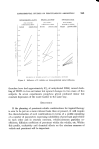
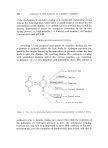
p--BENZOQUINONEDIIMINE 255 is the prior oxidation of the diamine to the diimine which is rate controlling. Nevertheless, we have found that the commonly employed couplers are even more reactive towards the diimine, than is p-phenylenediamine. Thus, accepting the overall mechanism in Fig. 1, this relative reactivity of p-diamine and other couplers explains the previous observations that Bandrowski's base is formed during the in vitro oxidation of the p-diamine alone, but not when the p-diamine is oxidised in the presence of equimolar amounts of resorcinol (2, 4) or of 2, 4-diaminoanisole (2). In fact, since the dyeing process entails oxidation of only a small proportion of the available diamine, even relatively small amounts of such couplers would be expected to inhibit the formation of the characteristic brown diamine oxidation products. This has been observed by Tucker in tress dyeing (2). These observations, together with those given earlier (1), lend further support to the mechanism outlined in Fig. 1. DETECTION OF THE DIIMINE Since the p-diamine is less reactive than other commonly employed couplers, it can be concluded that if the formation of the diimine is to be demonstrated, it is most likely so to be in the oxidation of p-phenylenedi- amine in the absence of other couplers. Under these circumstances we need consider only three processes:- Oxidation: p-Diamine (P) + oxidant Coupling: k2 3D + P (as "catalyst")* -- Hydrolysis: kl D-- monoimine -NH 3 -NH 3 kl ß • diimine (D) (i) * Bandrowski base (B) (ii) benzoquinone "Humic acid" (iii) Dolinsky et al (3) reported that peroxide oxidation of the diamine gave small amounts of other products, but for the present purpose these can be ignored since they represent 10% of the reaction. According to (i)-(iii) the diimine is formed by oxidation of the diamine:-- d [D•/dt = k' 1 [P] [Oxl *Here "catalyst" implies that while the presence of p-diamine is essential to the formation of Bandrowski's base, it is consumed in the first step (rate controlling) but regenerated in the final step.

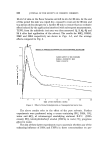
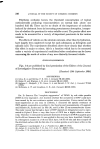
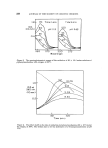
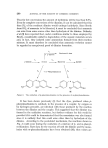
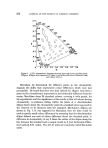
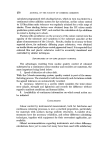
256 JOURNAL OF THE SOCIETY OF COSMETIC CHEMISTS and consumed by coupling and/or hydrolysis:.-- -d [D]/dt =3k 2 [P] [D] q- k 3 [D]* The most favourable conditions for the detection of the diimine are thus when reaction (i) is fast compared with reactions (ii) and (iii). This is the case when ferricyanide is used as the oxidant and the formation of the diimine can then be demonstrated spectrophotometrically (1, 5). I.O O.D. (i0 mm) 0.5 i \ I : I ß I I I i '" 22O 25O 28O Wave length Figure oe. The spectra of A, p-benzoquinonediimine B, p-benzoquinonemonoimine and C, p-benzoquinone in pH 9 aqueous buffer. All solutions were 50 X 10-6 molar. In view of its characteristic uv absorption spectrum (Fig. 2), the spectrophotometric method offers the best means of unequivocal detection *The factor 3 arises since the value of k 2 is for the rate controlling coupling step between one molecule of diimine and one molecule of diamine. In subsequent rapid reactions, two further molecules of diimine are consumed, one for a further coupling step and one as an oxidant, thus regenerating the diamine (6):-- k2 D q- P . .2, 5, 4'-triaminodiphenylamine slow fast D q- 2,5,4'-triaminodiphenylamine Reduced B fast D q- ReducedB . Bq- P
Purchased for the exclusive use of nofirst nolast (unknown)
From: SCC Media Library & Resource Center (library.scconline.org)