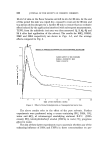
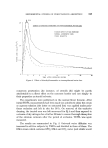
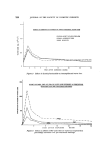
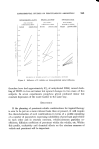
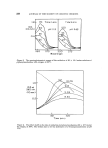
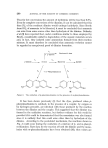
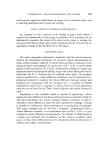
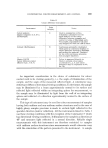
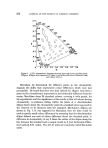
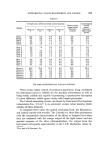
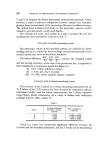
p--BENZOQUINONEDIIMINE 261 I.O O.D. (40 turn) 0..5 A I I 500 600 700 Wavelength Figztre 6. Spectra of the reaction mixtures during the oxidation of equimolar mixtures of p- and m- phenylenediamine by oxygen, at pH 11.2. The diamine concentrations are A, 0.01 molar B, 10-3 molar C, 0.5 X 10⁻³ molar and D, 0.1 X 10⁻³ molar. The curves E and F are respectively the spectra of the indamine dye (g7.5 X 10-6 molar) and the indoaniline dye (8.0 X 10⁻⁶ molar), at pH 11.2. I.O O.D. (40 mm) 0.5 A 500 600 700 Wavelength Figure 7. Spectra of the reaction mixtures during the oxidation of equimolar mixtures of p- and rn-phenylenediamines by hydrogen peroxide (0.25 X 10⁻³ molar), at pH 11.2. The diamine concentrations are A, 0.01 molar B, 10-3 molar and C, 0.5 X 10⁻³ molar.

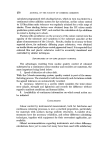
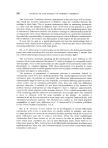
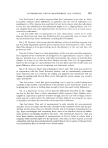
262 JOURNAL OF THE SOCIETY OF COSMETIC CHEMISTS available for k2, k4, k 5 and k 6 in Fig. 5. It can be seen that any diimine formed would undergo hydrolysis to monoimine and coupling, to give the indamine dye (III) and Bandrowski's base, in the ratio k2:k 5 [m-diamine 1: k 3 [p-diamine] and that the monoimine would undergo hydrolysis and coupling, to give the indoaniline dye (IV), in the ratio k4:k 6 [m-diamine•. Thus, the initial formation of the diimine would be indicated if the forma- tion of the indoaniline dye (IV) could be demonstrated. This should be possible if the oxidation is carried out under conditions where:-- k2 k • [m-diamine • k 3 [p-diamine • (iv) and k 6 [m-diamine-I k4 (v) from available rate data these conditions should pertain for the oxidation of a solution containing 0.1 X 10⁻³molarp-diamine and 0.1 X 10⁻³ molar m-diamine at pH 11.2 where (iv) and (v) are, numerically:-- 0.027 4.2 X 10⁻³ 0.725 X 10⁻⁶ min-1 0.065 0.017 min-1 and, initially, about 69% of any diimine formed should be converted into the indoaniline dye (IV) while only 13ø//o will couple to form the indamine dye (III)*. When the experiment was performed using oxygen as the oxidant, the formation of the indoaniline (IV) was clearly shown, by its characteristic absorption at 630 nm, in the spectrum of the reaction mixture (Fig. 6). Similar experiments using hydrogen peroxide (0.2 X 10⁻³ to 3 X 10⁻³ molar) as oxidising agent failed to develop any colour. This was evidently due to rapid destruction of the dyes by the peroxide. It was found, however, that colour developed in similar reactions when higher concentrations of the diamines were employed under these conditions, coupling of the diimine with the m-diamine would be expected to become increasingly significant (initially 40% with 0.5 X 10⁻³ molar, 76% with 10-3 molar, and 98}/0 with 0.01 molar solutions)*. Examination of the spec- tra of oxygenated mixtures, in Fig. 6, shows that they agree well with the kinetic predictions. Similarly the curves for hydrogen peroxide oxidation (Fig. 7) show evidence of the formation of the indoaniline dye (IV) in addition to the indamine (III). Comparison of these curves with those in Fig. 6 shows that, as was found by independent experiments, the dye (IV) is more susceptible to degradation by peroxide than is the dye (III). Since these predictions were based on a knowledge of the rates of reaction of the imines, the results indicate that the diimine is, almost certainly, the *These percentages ignore any diimine which is reduced back to p-diamine in the oxidation of leuco-dyes (6, 10).
Purchased for the exclusive use of nofirst nolast (unknown)
From: SCC Media Library & Resource Center (library.scconline.org)