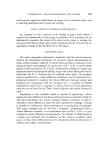
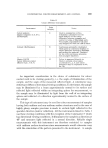
INSTRUMENTAL COLOUR MEASUREMENT AND CONTROL 277 an accurate tristimulus colorimeter. The repeatability of colour measure- ment of the Colorede has been obtained using the same pattern, following instrument recalibration (Table VI). Value X ¾ Z Table VI Average difference between repeat readings --0.334 --0.3O6 --0.0717 95 % Confidence interval --0.547 to --0.121 --0.544 to --0.068 --0.329 to --0.185 The repeatability of colour measurement is high, provided attention is given to positioning the sample pattern in the plane of measurement of the optical head. When the Colorede is used on-line in the paper machine, just before the reel, with the moving paper substrate passing below the white tile holder and above an opaque backing of the same reflectance as the substrate (maximum pass line variation + 6.35mm) it is sensitive to colour differences of the order of 0.7 MacAdam units. The stability of the instrument, which was unaffected by the paper machine operating environment, makes it particularly suited to the control of colour in continuous production units. The time between recalibration in continuous operation is as long as 8 hr (Table VII). Table VII Drift on colour difference meters with time 8hr 24 hr Change in AX, AY and /XZ at 100 % reflectance level ___0.3 _+0.5 PRACTICAL RESULTS OF QUALITY CONTROL ON THE PAPER MACHINE The requirement for a commercial match for "fine" papers has been found to be: patterns exhibiting a combined chromaticity and luminosity difference of not greater than 3 MacAdam units (approximately 3 traces in colour or 15ø//o in strength). By passing the Colorede output to an analogue

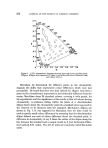
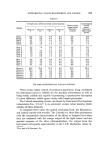
278 JOURNAL OF THE SOCIETY OF COSMETIC CHEMISTS calculator programmed with shading factors, which in turn was linked to a continuous colour addition system for dye solutions, on-line colour control to 1.5 MacAdam units tolerance was regularly attained for a wide range of shades. These shading factors were obtained from the ICI colour match prediction system called 'IMP', and enabled the calculation of dye additions to correct a dyeing on to shade. Factors with an influence on the accuracy of the colour control were the opacity of the substrate and variations in the substrate pass-line at the plane of measurement of the Colorede. Results, similar in accuracy to those reported above, for uniformly diffusing paper substrates, were obtained on textile fabrics and polythene coated pigmented board. It is expected that coloured film and plastic substrates could be accurately monitored and controlled by similar techniques. ADVANTAGES OF ON-LINE QUALITY CONTROL The advantages resulting from on-line quality control of coloured substrates by a continuous colour monitor and recorder are numerous, the more important being listed below: 1. Speed of detection of colour drift. With the Colorede measuring system, quality control is part of the manu- factuddng process. The standard is held electronically and deviations outside the agreed tolerance are automatically recorded. 2. Accuracy, inherent in a system which considers the total colour error (shade, strength and lightness) and records the difference without regard to ambient conditions and human foibles. :3. Availability of continuous information on which sound action can be initiated. CONCLUSIONS Colour control by instrumental measurement, both for batchwise and continuous colouring processes, is now a practical proposition, particularly for mateddais with surfaces having uniform structures. A number of in- struments have the necessary reliability, and colour difference calculating techniques, together with equipment for their convenient application, are available. Official recommendations regarding instruments and colour difference calculations have yet to come but many have been used with satisfactory
Purchased for the exclusive use of nofirst nolast (unknown)
From: SCC Media Library & Resource Center (library.scconline.org)