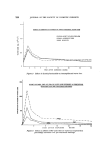
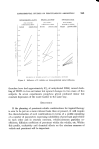
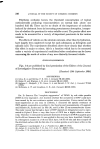
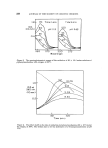
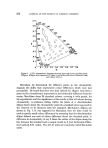
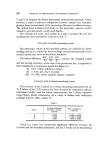
EXPERIMENTAL STUDIES ON PERCUTANEOUS ABSORPTION 247 ioo o •o 0 50- OOl 4o L•• Forearm Forearm J Isoft white '• • I paraffin N I lo.Ommj x k o N j •j O'?mm j•øJo'JO j mm •5 50 25 20 Temperature, øC Figure 6. surface. Only a 0.06 mm thick layer remained on the skin, as estimated from the weight of the recovered SW'P. Perhaps the SWP had meanwhile spread over the skin surface to about 8 x 13 -- 100 cm 2 so that the layer had been reduced to about 0.03 mm SWP. In order to estimate the resultant retardation of the evaporation, indicated by you as occlusivity, I would like to propose the resistance of the skin and the resistance of the SWP layer against water permeation as parameters, because the resistances of both layers can be added while the permeabilities cannot. The resistance (r) is found in analogy to Ohm's law: (C ,--C 2) M/At (C •--C2) represents the difference of the xvater concentrations at both sides of the membrane M represents the amount of water permeated through an area of A cm-2 per unit of time (t). The value of (C •--C 2) at 33øC skin temperature, carrying dry air over the skin in our experiments, is 35.3x 10 -3 mg cm -3. The value of M/At is found

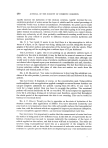
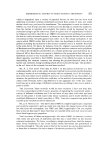
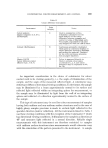
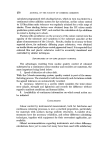
248 JOURNAL OF THE SOCIETY OF COSMETIC CHEMISTS from the water vapour loss in mg cm-2 h-1. In Table II the resistance has been cal- culated from the estimated water vapour loss of some experiments. Table II Measurement of the permeability of skin at 33øC at 23øC (E----64 kJ mole-') 0.01 mm thick layer of SWP soft white paraffin at 33øC at 23øC forearm skin id q- SWP for 15 min t h later It h later 2• h later 4 h later (+ sweating) Water vapour loss found in mg cm -2 h -1 0.20 0.09 0.21 0.09 0.60 0.054 0.192 0.150 0.144 0.27 Occlusivity complete partial complete complete partial Resistance to water vapour loss in 103 s cm-• 0.63 0.81 0.60 0.83 0.21 2.3 0.66 0.84 0.88 0.47 Increased barrier quality 1 x (nothing) 11x 3.1x 4.0x 4.2x 2.2x The SWP permeability has been calculated from measurement at a 2.7 mm layer of SWP. The values indicate that the barrier is much increased (11 times) immediately following the application of the SWP. It is increased twice or three times about an hour later when a stationary state has been obtained. This increase can have been obtained by a 0.02 or 0.03 mm thick layer of SWP. As the thickness of the layer of SWP probably has been the same, the explanation of the occlusive effect of the SWP may be its high specific resistance against water evaporation. It has been supposed that the skin is completely flat and that the layer of SWP spread over the skin has the same thickness everywhere. However, at the sweat duct opening the absorbed layer of SWP may be thicker than at normal stratum corneum. I wonder whether a failure of the correlation of the experimentally found water vapour loss of SWP-treated skin with the summation of the water vapour loss of the non-treated skin and the layer of SWP might provide some information about such phenomena. According to your definition, "occlusivity" will be obtained by the spreading of a layer with a water vapour loss to less than 25% of the skin's TEWL ("complete suppression"). Accordingly the resistance of this layer will have to amount to three times the resistance of the investigated skin and it therefore depends on the TEWL of the investigated skin. I should like to know whether this "occlusivity" has to be chosen as a criterion or the average thickness of the relevant layer of occlusive material (SWP). Maybe "occlusivity" is medically preferred and "increase of re-
Purchased for the exclusive use of nofirst nolast (unknown)
From: SCC Media Library & Resource Center (library.scconline.org)