2•3•3 JOURNAL OF THE SOCIETY OF COSMETIC CHEMISTS colour within tolerance. Modern high speed methods of manufacture, where material is coloured continuously as it passes through the machine, serve only to highlight the shortcomings of antiquated colour control methods, and off-machine subjective quality control is no longer sufficient for today's packaging materials. Colorimetry presents an opportunity to define toler- ances in precise mathematical terms. Provided all parties accept the instrumental decision as to whether material is acceptable or otherwise, problems of variable visual judgment, and disagreement between tolerance sizes set by different observers are removed. The multiplicity of colour measuring instruments and methods for colour difference determination presents advantages and disadvantages. On the one hand, the user is able to select equipment which is most suited to him with regard to cost and convenience of use. On the other hand, progress toward standardisation of equipment and application techniques for colour tolerance setting has been impeded. Enough information has been collected, however, to permit some recommendations to be made and to indicate the reliability of certain techniques. There is, nevertheless, a considerable amount of work still to be done before a clear picture emerges, and before the C.I.E. will be in a position to make official recommendation on the subject. THE ROLE OF INSTRUMENTATION IN COLOUR CONTROL There are three distinct types of application of instruments in colour control work: Colour control in a batchwise colouring process A sample of material is removed from the machine at the end of the colouring process, its colour measured and the colour difference of the sample from the control determined. An additional colouring process is carried out if the sample is outside tolerance. Colour sorting Batches of material which have been coloured in separate processes and accepted as being within a given colour tolerance may require sorting into lots which fall within a smaller colour tolerance. This problem occurs mainly in the textile industry where cloth from different dye lots may be

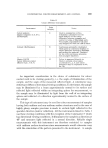
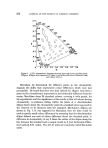
INSTRUMENTAL COLOUR MEASUREMENT AND CONTROL 267 made up into a garment which must, of course, have a uniform colour, and in selecting matching reels of paper for cutting. Colour control in a continuous colouring process An example of such a process is the dyeing of paper sheet which is carried out continuously as the paper is produced. It is necessary for an instrument to monitor the colour of the sheet as the paper is leaving the conveyor belt before reeling. Any colour variations must be corrected by an appropriate change in the dye flow rate to the paper. INSTRUMENTATION The colour measuring instrument commonly used for colour tolerance work is the tristimulus colorimeter. It produces colour measurements in terms of three numbers called X, Y and Z, which are the co-ordinates of the system of colour measurement set up by the C.I.E., or R, G and B which may be easily converted to X, Y and Z. Colorimeter readings on sample and standard cannot be substracted directly to give the colour difference between them since the X, Y, Z system is not a uniform colour space. The readings may be inserted into a colour difference formula or may be processed by a graphical treatment to produce the colour difference between sample and standard, for comparison with the tolerance set. A number of reliable colorimeters which have a response to colour which is in close agreement with the eye are listed in the Table I which indicates the salient features of each. Equipment is also available which is capable of producing a direct display of colour difference and three such instruments are listed in Table II. The first instrument, the Colour Analysis Display Computer (C.A.D.C.) calculates colour differences when fed with colorimeter readings. Colorede is suitable for continuous colour monitoring of a moving piece of material. The colour readings may be fed into a computer, programmed with a colour difference formula, or an instrument such as the C.A.D.C. to give continuous colour difference measurements. The Hunter D 25M measures a colour and calculates the co-ordinates of the colour in uniform colour space, so that colour differences may be obtained by direct subtraction of control and sample measurements.
Purchased for the exclusive use of nofirst nolast (unknown)
From: SCC Media Library & Resource Center (library.scconline.org)