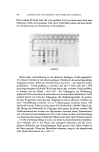
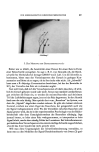
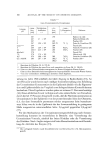
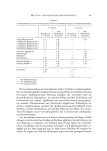
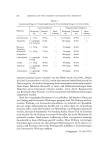
8O2 JOURNAL OF THE SOCIETY OF COSMETIC CHEMISTS "noise" in a system of this type and that it is difficult for individuals to differentiate between noise and signals. In order to avoid this difficulty, it is useful to use Swets's model of signal detection theory (Ref. 3, Fig. 6). On the abscissa (Fig. 6) the response intensity is plotted, i.e., the subjective certainty that a response is noted. The ordinate shows the frequency. The curve on the left shows the distribution ofa subject's estimates when only air is offered, whereas the curve on the right shows the distribution when a small concentration of an o. is offered. Where the curves cross, it is impossible to decide between signal and noise. Each subject must set his own criterion in deciding whether a stimulant is offered or not. Whenever the number of erroneous judgments in the case of air and of an o. is known, then the position of the critical range can be calculated. If one assumes a Gaussian distribution for the observations, then the difference (d') between the maxima of the two distributions is a measure of sensitivity which is independent of the judgment tendencies of the observer and is, therefore, superior to the threshold value. The standard deviation of the distribution was set equal to 1 thus d' ranges between 0 and 2. 3. Experimental Setup 3.1 The following stimulants were introduced: civet absolute mustard oil (allylisothiocyanate) n-butyric acid onion oil dimethylsulfide linalylacetate 3 x10 -s mol/1. of air 3.5 x 10 9 mol/1. of air 3.5 x 10 -9 mol/1. of air in diethyl phthalate 3.5x 10 -9 mol/1. of air 3 x10 8 molil. of air 3 X 10 -5 mol,'l. of air 3.2 The "odor eliminators" were two commercially available concentrates (Ref. 3, 4). 3.3 The sensitivity to the five unpleasant o.s and to linalylacetate was determined by four subjects. The calculations of d' requires about 100 tests by each subject. At first, that concentration for each individual was determined which was recognized correctly in 80% of the tests. Similarly, the o.e.s were offered alone to determine that concentration at which their odors could no longer be recog- nized. Thereafter the o. alone, mixtures of o. and o.e., and air alone were tested in a random fashion. The effect of the o.e. was read by determining the value of the sensitivity measure d' of the mixture of the o. and the o.e. as well as of the o. alone. 3.4 Two experimental procedures were used. In the first one the o. and the o. e. were offered to the individual immediately after mixing. 3.5 In a second setup (Fig. 7) the o. and the o.e. were mixed and retained for 10 minutes before they were offered to the subject. 4. Results 4.1 In this particular case civet (absolute), mustard oil, and n-butyric acid, and onion oil were tested. The results are shown in Fig. 8 in which values for d' for the pure o. (R) and for the same o. mixed with either o.e. M or o.e. N are given. The height of the columns d' indicated in all five cases that the pure o. was more readily discernible than if the o. was offered in the presence of either product M or N following test procedure 3.5. 4.2 The experiment with essentially no mixing period (procedure 3.4) was conducted with mustard oil, n-butyric acid, dimethylsulfide, and linalylacetate. The results are shown in Fig. 9, which indi- cates that under these conditions there is no evidence that the o.e. is effective. 5. Interpretation of Results 5.1 Whenever the o.e.s have time to interact with the o., they lower the sensitivity towards the o. It can be concluded therefore that the o.e.s do not act via anesthesia. 5.2 The slight increase in sensitivity for mixtures of o. and o.e. after brief mixing times is due to an additive effect which is well-known to perfumers. 5.3 The question of how effective the so-called o.e.s are can be answered on the basis of additional comments from the observers. From this information, it is concluded that the reductions of sensitivity

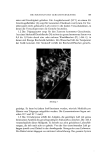
DIE SOGENANNTEN GERUCHSVERNICHTER 803 by o.e. M ranges from 14.4 to 41.3%, with an average of 28.7% the range for o.e. N is from 3.2 to 27.2% with an average of 14.5%. Although the effect is definite under the described laboratory conditions, the effect of the o.e. concentrations which may exist in practice is probably low. This is due to the fact that o.s and other malodorous materials are normally found in much higher con- centrations than those tested in the laboratory and that a high dose of the o.e. would add an unde- sirable level of its own odor. 5.4 It has been established that the o.e.s act both on pleasant and unpleasant odors. GERUCHSVERNICHTUNG Die Beseitigung schlechter Geriiche ist seit jeher ein verstiindlicher Wunsch zivilisierter Menschen. Als ein Weg zur Verbesserung verdorbener Raumluft in Haushalt, Biiro und Betriebsriiumen wurde die chemische Umwandlung yon Stinkstoffen in weniger unangenehm riechende Stoffe vorgeschlagen. Man setzt hierzu bestimmte chemische KiSrper mit sehr reaktionsfreudigen funkdo- nellen Gruppen ein. Es ist bekannt, dab z.B. Verbindungen wie Fumarsiiure oder Crotonsiure dutch ihre Doppelbindung in Konjugation zur Carboxyl- gruppe Anlagerungsreaktionen mit vielen Substanzen wie Merkaptanen, Halogenen oder Aldehyden eingehen kiSnnen. Nach diesem Prinzip wirkende Stoffe werden zur Verwendung in Aerosolform, also hauptsichlich in Raum- sprays, angeboten. Da sich die subjektiven Meinungen iiber die Wirksamkeit dieset Stoffe auf schlechte Geriiche widersprechen und man dariiber hinaus Abbildung 1
Purchased for the exclusive use of nofirst nolast (unknown)
From: SCC Media Library & Resource Center (library.scconline.org)