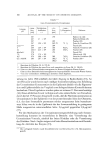
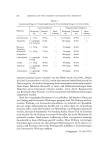
832 JOURNAL OF THE SOCIETY OF COSMETIC CHEMISTS Tabelle 2 Zusammenstellung yon Versuchsergebnissen bei Fototoxizitiitspriifungen mit Arzneimitteln. Priiparate Cutane Applikation Dosierung Bestrahl.- Beob- tgl. zeit achtung Intraperitoneale Applikation [ Bestrahl.- Beob- tgl.
Dosierung zeit achtung Chlorpromazin 2 x 2,5% Tetracyclin 2 x gesiittigte LtSs. in Aceton 72 Std. + 16,5 mg/kg 48 Std. +--4- 72 Std. -- 100 mg/kg 48 Std. d-z_ Bithionol Tetrachlor- salicylanilid Griseofulvin Chlorothiazid Acridin Anthracen Anthrachinon 2 x 5%ig 72 Std. + 50 mg/kg 48 Std. 2 x 5%ig 72 Std. --+ 10 mg/kg 48 Std. 100 mg/kg 48 Std. 2 x gesiittigte 72 Std. d 50 mg/kg 48 Std. Lbsung 2 x 5%ig 48 Std. --+ 50 mg/kg 48 Std. 2 X gesiittigte 48 Std. --+ 100 mg/kg 48 Std. Lbsung 2 x gesiittigte 72 Std. 100 mg/kg 48 Std. Lbsung trationen ausl•Ssen lassen. Deutlich war der Effekt bereits bei 0,04%. Bereits bei einer Konzentration yon 0,6% wurde eine maximal starke Reaktion auf der Haut ausgel•Sst, die auch bei Steigerung der Konzentration nicht mehr zunahm. Nach diesen Befunden iiberrascht es nicht, dab Paffiimzubereitungen beim Menschen schon fototoxisch wirksam wetden, wenn dutch Bergamotte•51 nut Bruchteile eines Prozents yon Furocumarinen in die Pafftimzubereitungen eingebracht wetden. Nach den vorgelegten Resultaten ist zu schlieBen, dab haarlose M•iuse gut zur Priifung auf fototoxische Wirkungen geeignet sind. Die Priifung auf foto- toxische Wirkung yon Kosmetikvorprodukten ist sicherlich ein Spezialfall, der nut einige Substanzklassen betrifft und vor allem dann zur Anwendung kommen sollte, wenn die Produkte zur Herstellung yon Priiparaten gebraucht wetden, die beim Sonnenbaden Verwendung finden. Dieset Test ist sicherlich auch niitzlich fiir die Priifung yon neuen Rohstoffen, die in der Parftimerie (3) gebraucht werden. Nach unserer Auffassung solken vorzugsweise neuartige Grundstoffe in dieset Richtung gepriift werden. Einer Priifung yon fertigen Formulierungen messen wit eine geringere Bedeutung bei. Es ist nicht zu er- warren, dab Produkte, die bei der Priifung nicht auffallen, in Formulierungen eine fototoxische Wirkung enffalten. (l•ingegangen : 13. Juli 1970)

PRI•FUNG VON KOSMETIK-GRUNDSTOFFEN 833 LITERATUR (1) Baer, R. L., ,Klinische und immunologische Untersuchungen fiber Lichtallergie'. Der Hautargt 19, 82-86 (1968). (2) Buchnifiek, J., Turck, B., 'The inhibitory effect of mepacrine and chloroquine on the photo- dynamic action'. Argneimittelforschung 17, 760-761 (1967). (3) Burdick, K. H., 'Phototoxicity of shalimar perfume'. Archives of Dermatology 93, 424-425 (1966). (4) Caporale, G., Musajo, L., Rodighiero, G., Baccichetti, F., 'Skin-photosensitizing activity of some methylpsoralens'. Experientia 23, 985-986 (1967). (5) Chadshai, J. I., Kusnetzowa, W. F., 'Photosensibilisierende Wirkung von Furocumarinen'. Farmacevlycnyj Z. 20, 66-70 (1965). (6) Daniels, F. (jr.), 'A simple microbiologica method for demonstrating phototoxic compounds'. J. Invest. Derm. 44, 259-263 (1965). (7) Epstein, S., Enta, T., Mehregan, A. H., 'Photoallergic contact dermatitis from antiseptic soaps'. Dermatologica 136, 457-476 (1968). (8) Freemann, R. G., Troll, D., Knox, J. M: 'Photoreactivation from the effects of 300 nm and 250 nm monochromatic ultraviolet radiation in albino mouse skin'. Texas Reports on Biol. and Med. 26, 309-312 (1968). (9) Gloxhuber, Ch., ,Zur Methodik der toxikologischen Priifung von Kosmetika'. J. Soc. Costa. Chem. 21, 313-342 (1970). (10) Granick, S., 'Induction of the synthesis of deltaaminolevulinic acid synthetase in liver paren- chyma cells in culture by chemicals that induce acute porphyria'. J. biol. Chem. 238, 2247-2249 (1963). (11) Ippen, H., ,Physikochemische Grundlagen der Lichtwirkung auf die Haut'. ?ette, Seifen, An- strichmitte170, 669-673 (1968). (11a) Ippen, H., ,Einfache in vitro-Untersuchungen zur photcdynamischen und photoallergischen Reaktion'. Arch. f. klin. u. exptl. Dermatol. 237, 499-501 (1970). (12) Ison, A. E., Davis, Ch. M., 'Phototoxicity of quinoline methanols and other drugs in mice and yeast'. J. Invest. Dermat. 52, 193-198 (1969). (13) Kobori, T., Araki, H., 'Photosensitive dermatitis as an iatrogenic disease'. XIII. Congressus internationalis Dermatologiae, Mfinchen, vom 31. 7.-5. 8. 1967, Vol. II 1357-1358. (14) Matteis, F. de, Rimington, C., 'Disturbance of porphyrin metabolism caused by griseofulvin in mice'. Brit. J. DermatoL 75, 91-104 (1963). (15) Musajo, L., Rodighiero, G., Breccia, A., Dall'Acqua, F., 'Skin-photosensitizing furocouma- tins photochemical interactions between DNA and--OCHa Bergapten (5-Methoxypsoralen). Photochemistrj and Photobiology 5, 739-745 (1966). (16) Owens, D. W., Glicksman, J. M., Freemann, R. G., Cames, R., 'Biologic action spectra of 8-methoxypsoralen determined by monochromatic light'. J. Invest. Derm. 51, 435-440 (1968). (17) Peters, H. A., Johnson, St. A.M., Cam, S., Oral, S., Mtiftti, Y., Ergene, T., 'Hexychloro- benzene - induced porphyria effect of chelation on the disease, porphyrin and metal meta- bolism'. Am. J. Med. Sci. 251, 314-322 (1966). (18) Polano, M. K., 'Photosensibility due to drugs',Drug induced diseases 102-107 (1965). Editor: L. Meyler, Excerta Medica Foundation. Amsterdam. (19) Raab, O., Jodlbauer, A., Tappeiner, H., ,Die sensibilisierende Wirkung fluoreszierender Sub- stanzen', Leipzig 1907, zit. nach Blum, H. F., 'Photodynamic action and disease caused by light'. Hafner New York 1964. (20) Sams, W. M., Epstein J. H., 'The experimental production of drug phototoxicity in guinea pigs'. J. Invest. Derm. 48, 89-94 (1967). (21) Wilkinson, D. S., 'Further experiences with halogenated salicylanilides'. Brit. J. Dermatol. 74, 295-301 (1962). (22) Wilkinson, D. S., 'Patch-test reactions to certain halogenated salicylanilides'. Brit. J. DermatoL 74, 302-306 (1962).
Purchased for the exclusive use of nofirst nolast (unknown)
From: SCC Media Library & Resource Center (library.scconline.org)