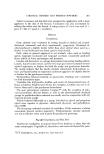
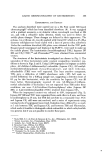
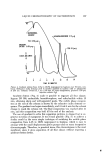
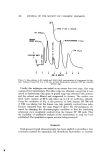
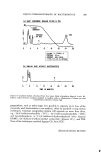
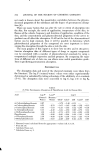
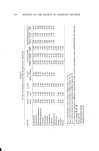
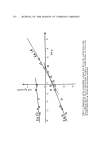
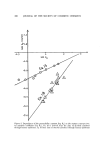
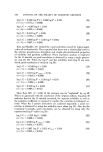
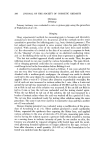
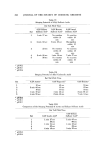
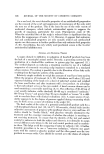
380 JOURNAL OF THE SOCIETY OF COSMETIC CHEMISTS "• 2.C -0.5 -1. o, LOG K m -/4.0 a -6.0 '7.0 Figure 2. Dependence of the permeability constant (log Kp) on the stratum corncure/wa- ter partition coefficient (log K•n). Eq i0 is derived from the data of alcohols absorbed through human epidermis eq 18 from data of steroids absorbed through human epidermis

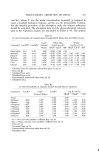
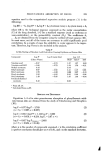
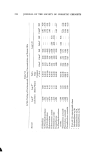
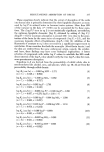
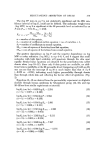
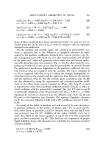
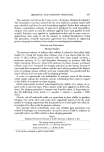
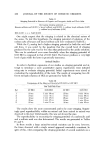
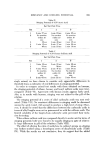
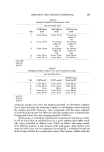
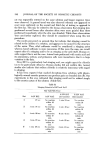
PERCUTANEOUS ABSORPTION OF DRUGS 381 log Kv (cm/hr) = -0.207 (log p,)2 q_ 1.494 log P' - 5.425 (20) (n = 10, r = 0.978, s = 0.220, log P'o = 3.60 ñ •) log D (cm2/sec X 10 -•a) = 0.527 log P'(et•er) q_ 1.000 (21) (n = 10, r = 0.918, s = 0.240) log D (cm2/sec x 10 -•a) = -0.221 (log P')"' + 1.170 log P' + 0.734 (22) (n = 10, r = 0.961, s = 0.180, log P'o = 2.64 (2.04-11.08)) Some of these equations have been reported previously (4), and are now in- cluded using the cm/hr unit for Kv in order to compare with the equations obtained from rabbit skin. For the alcohols and steroids, again, the variation in permeability con- stants is primarily due to the difference in lipophilic character as repre- sented by the partition coefficients obtained from various systems (eqs 13- 22). Comparing eq 6 xvith eq 14 one sees that nonelectrolytes and alcohols of the same log P value will penetrate rabbit whole skin and human epider- mis with about the sa•ne rate constant (Fig. 1). On the other hand, by com- paring eq 15 with eq 18 one can see that the permeability of steroids through the epidermis is much more dependent on the partition coefficient into stra- tum corneum (K,•) as compared with the alcohols. The lower intercept of eq 18 as compared with that of eq 15 reflects the stronger hydrophobic in- teractions between the steroids and the epidermis than between the alcohols and the epidermis (Fig. 2). For the steroids, good correlations (eqs 19, 20) are also obtained by using the experimental and estimated partition coeffi- cient in the ether/water system reported by Flynn (16). Log P' is used to represent the ether/water partition coefficient instead of log Kv in order to avoid confusion with the permeability constant. The (log p,)2 term in eq 20 is statistically significant at the 90 percentile level (F•.7 = 4.29 F•,7 ..... = 8.59). Equations 21 and 22 are obtained from the diffusion data. Both eqs 20 and 22 point to the departure from linearity. The optimum lipophilic character log P'o for maximum diffusion is 2.64 with a 95% confidence interval of 2.04- 11.08. In a study of the ability of nicotinic acid and several of its ester derivatives to produce erythema on the surface of human skin (17) no good correla- tion, either linear or parabolic, could be obtained when only the log P' term was examined (eqs 23, 24). Addition of the molar solubility term log S (mole/liter H20) to the linear equation of log P' for 6 of the compounds gives excellent correlation (eq 27). This indicates the importance of proper lipoid solubility along with adequate water solubility for maximum localized erythema activity. log 1/C = 0.416 log P'tot•o,.• q_ 2.281 (n = 8, r = 0.598, s = 0.757) (23)
Purchased for the exclusive use of nofirst nolast (unknown)
From: SCC Media Library & Resource Center (library.scconline.org)