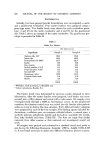
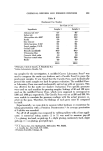
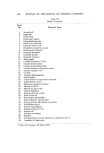
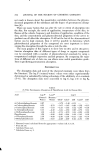
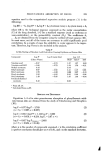
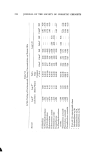
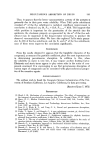
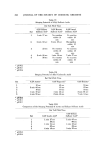
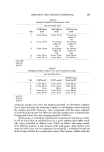
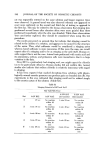
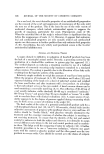
392 JOURNAL. OF THE SOCIETY OF COSMETIC CHEMISTS rat was repeatedly retested on the same solution and longer response times were observed. A general trend was also observed wherein rats appeared to react more uniformly on the second and third day of testing as opposed to the first day. This may be related to the human observation that stinging tests performed several hours after abrasion often were more painful than those performed immediately after the skin was abraded. While these observations were not further explored, they should be considered when using this test procedure. The results presented on animals thus far indicate that stinging cannot be related to the acidity of a solution, and appears to be caused by the structure of the anion. Thus, ethyl sulfonate would be considered a stinging anion whereas lauryl sulfonate is more innocuous. If this were the case, one would expect salts of a stinging acid to be as stinging as the acid itself. Human re- suits suggest this is not the case. Animal tests performed with acetic acid and its ammonium, sodium, and potassium salts were inconclusive due to a large variation in the data. Since HC1 is a particularly bad stinging acid, one might expect the chloride ion to be particularly offensive. Human studies did not confirm this. Animal studies also indicate that sodium chloride is relatively innocuous with regard to stinging. It has been reported that marked deviations from solutions with physio- logically normal osmotic pressures can produce pain on denuded skin (6). Our experiments in this area indicated that stinging could not be related simply to the osmotic nature of the solution (Table XI). Table XI Stinging Potential of HC1 and NaC1 Rat Tail Flick Time 0.15N HC1 0.15N NaC1 Rat 0.3N HC1 0.3N NaC1 (Iso-osmotic) (Iso-osmotic) I 27 sec No reaction 1 rain 51 sec No reaction within 10 w•thin 10 rain rain 2 1 rain 34 see No reaction 1 rain 48 sec No reaction within 10 within 10 rain lnin 3 4 rain 08 sec No reaction 6 min 42 sec No reaction within 10 within 10 rain rain 4 I min 07 sec No reaction i rain 25 sec No reaction within 10 within 10 min min 5 1 rain 20 see No reaction 3 min 10 see No reaction within 10 within 10 rain rain

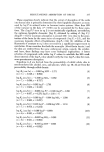
IRRITANCY AND STINGING POTENTIAL 393 From the data presented here, no general conclusions can be drawn, either as to predicting the stinging potential of a solution by considering its primary irritaney, its hydrogen ion concentration, its tonicity, or the nature of the anion. The etiology of the stinging phenomenon appears to be of a more com- plex nature than can be explained by these preliminary experiments. SUMMARY Animal and human methods for evaluating the stinging potential of mate- rials placed on the skin have been devised. Using these tests, various materi- als have been evaluated for stinging potential. In addition, the primary irri- tancy of some of these compositions has been evaluated. The results indicate that stinging potential and primary irritancy are unrelated. It was also ob- served that no general conclusions could be drawn as to predicting the sting- ing potential of solutions of acidic materials by considering solely the hydro- gen ion concentration, tonicity, or the nature of the anion. ACKNOWLEDGEMENT The author wishes to thank Mrs. J. Carver, Mr. M. Monaco and Mrs. C. Quirk for their technical assistance. (Received January 5, 1973) (1) Lansdown, A. B., An appraisal of inethods for detecting primary skin irritants, ]. Soc. Cosmet. Chem., 23, 739 (1972). (2) Finkelstein, P., Laden, K., and Miecho•vski, W., Laboratory methods for evaluating skin, Toxicol. Appl. Pharmacol., 7, 74 (1965). (3) Beechef, H., The measurement of pain, prototype for the quantitative study of sub- jective responses, Pharm. Rev., 9, 59 (1957). (4) Armstrong, D., Dry, R. M. L., Keele, C. A., and Markahm, J. W., Method for studying chemical exatants of cutaneous pain in man, ]. Physiol., 115, 59P (1951). (5) Blohm, S. G., The connection between skin irritating and protein denaturing effcct• of some surface-active agents, Acta Dermato-Venereol., 37, 269 (1957). (6) Keele, C. A., Chemical causes of pain and itch, Proc. Roy. Soc. Med., 50, 477 (I 957).
Purchased for the exclusive use of nofirst nolast (unknown)
From: SCC Media Library & Resource Center (library.scconline.org)