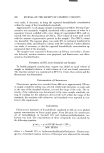
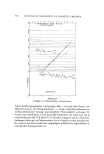
UPTAKE AND EXCRETION OF AEROSOL ANTIPERSPIRANT 649 Table II Distribution of Radioactivity following Inhalation Exposure (Twenty-four Hours a•ter Exposure) Monkey C Monkey D (tin x 104) (t•c x 104) Skin or skin substitute (per in. a ) 1070.00 3750.00 Nasal septum 12.74 3.52 Trachea 1.69 3.72 Bifurcation 1.19 N.D. Lung (total) 19.20 11.48 Liver 36.41 20.55 Kidney 3.89 5.02 Stomach 13.57 14.34 Esophagus 1.21 1.94 Bile 0.74 0.56 Feces 0.012 N.D. Exhaled radioactivity in 24 678.60 1740.90 hours as •CO2 or •C-IPM Table III Urine Levels of Radioactivity SampBng Time Monkey C Monkey D (Hours) (Total •c x 10 •) (Total/•c x 10 ') 0.38 0:832 0.0 ... 0.03 1.904 .. ß 1.55 0.02'8 ß ß ß 4.27 2.02 ... 5.88 2.04 ß ß ß 10.20 3.92 18.13 4'.• ... ... Table IV Blood • Levels of Radioactiivity Monkey C Monkey D Time of Sampling (Total •c x 10 •) (Total •c x 10 •) 5 min post exposure 0.0 0.0 24 hrs post exposure 0.55 0.0 •Assuming the blood volume to be 54.1 (44.3-66.6) ml/kg of body weight (1).

65O JOURNAL OF THE SOCIETY OF COSMETIC CHEMISTS Table V "Airborne" Concentration of Formulation in the Chamber Radioactivity/Liter Air t•g Formulation/Liter Air Monkey A 0.057 0.498 Monkey B 0.055 0.479 Monkey C 0.065 0.567 Monkey D 0.045 0.394 DISCUSSION Based on these values, calculations have been made of the amount of the product absorbed, the amount reaching the lower respiratory tract, and the percentage of radioactivity excreted in 24 hours. Estimation of the portion of the released dose reaching the lower respiratory tract was made in the following manner: Formula I: % ---- radioactivity* in trachea 4- bifurcation 4- lung x 100 total radioactivity released in chamber This was calculated to be 0.02%. The per cent of radioactivity remaining in any organ after 24 hours was calculated in the following manner: Formula II: % = radioactivity in an organ at 24 hours? X 100 radioactivity in an organ immediately after exposure* This was calculated to be 17.4% for the lung, 13.85% for the trachea, and 17.9% for the bifurcation. The average for the entire lower respiratory tract (so defined in Formula I) was 16.8%. It was not possible to calculate directly the total dose absorbed initially. Although very little activity could be found in tissues outside the respiratory tract, the amount in the nasopharyngeal portion of the tract could not be readily collected for quantitation. The amount could, however, ,be estimated in three independent ways which were in reasonably good agreement. First, the airbonze concentration in the chamber was measured using an air filter in the exhaust system to take out all the radioactivity. Using an average figure of 50 ml for the tidal volume and 30 breaths, this gives 833 x 10 -4 prc inhaled from the data in Table V. This figure is probably a little low since it does not include any material impinging directly from the spray in the mouth or nasal openings. *Mean of monkeys A and B. ?Mean from monkeys C and D. *Mean from monkeys A and B.
Purchased for the exclusive use of nofirst nolast (unknown)
From: SCC Media Library & Resource Center (library.scconline.org)